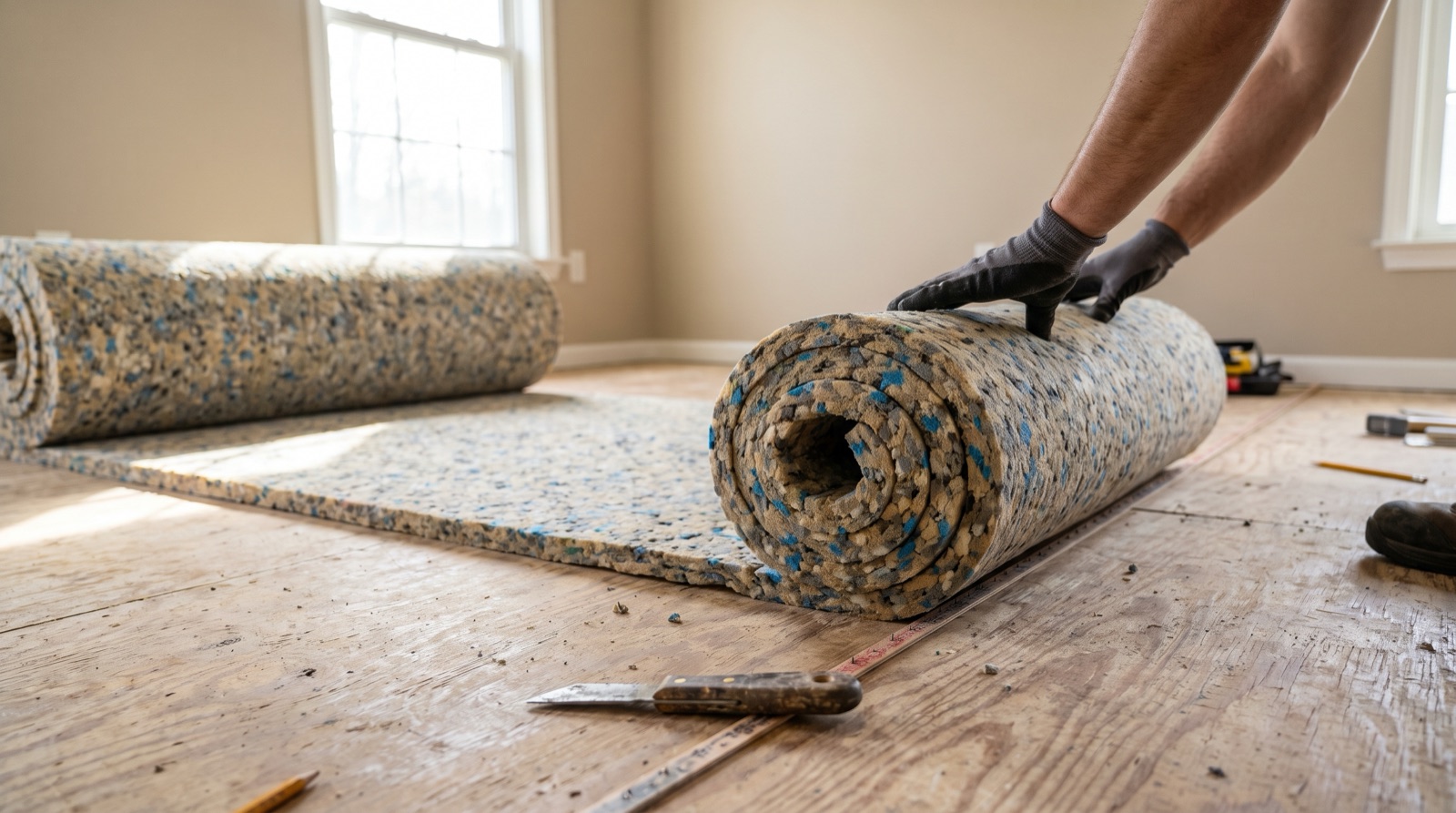
The short answer on carpet padding
Quick answer
For most DMV homes, an 8-pound-density rebond pad at 7/16 inch is the right call under cut-pile carpet. Density, measured in pounds per cubic foot, is what makes a pad last, not thickness. Go firmer and thinner on stairs and under Berber, and switch to a synthetic-fiber or rubber pad with a moisture barrier over a basement slab. The pad you cannot see decides how long the carpet you can see lasts, so it is worth getting right.
Padding is the most overlooked half of a carpet job, and the place the most money quietly leaks in a big-box quote. Homeowners pick the carpet by color and feel, then let a salesperson upsell a thick soft pad because it "feels luxurious in the store." Thickness is not the spec that matters. Density is. A dense pad holds the carpet's backing flat so the fibers do not grind themselves out, and it is the difference between carpet that lasts its full rated life and carpet that looks tired in five years. This guide walks the real decisions, the pad types, density, thickness, the warranty rule almost nobody mentions, and what it costs, the way we lay it out on a DMV carpet quote.
What carpet padding actually does
Quick answer
Padding does four jobs: it absorbs foot-traffic impact so the carpet backing does not break down, it adds insulation and warmth, it deadens footstep and room noise, and it makes the carpet feel comfortable underfoot. The first job is the important one. The pad protects the carpet, which is why the wrong pad shortens the carpet's life no matter how good the carpet is.
Think of the pad as the shock absorber for your floor. Every footstep drives the carpet backing down; a good pad cushions that impact and springs back, so the backing never gets crushed or cracked. A worn-out or too-soft pad lets the backing take the full hit, and once the backing breaks down the carpet develops ripples, wears in the traffic lanes, and loses its spring, even if the face fibers still look fine. The comfort and quiet you feel walking on it are real benefits, especially in a townhome where footstep noise carries between floors, but they are secondary to the structural job. That is why we never treat pad as an afterthought or a place to save a few dollars: cheap out on the pad and you shorten the life of the carpet sitting on top of it.
Padding types: rebond, foam, rubber, fiber
Quick answer
There are four common pads: rebond (the speckled, multicolor bonded-foam pad used on about 95 percent of residential jobs), prime foam (a softer single-color foam, lower grade), rubber (flat or waffle, denser and more durable, common in commercial and high-end work), and synthetic fiber or felt (firm and flat, the pick for Berber and for basements with a moisture barrier). For most DMV homes, a good rebond is the right, cost-effective choice; the exceptions are stairs, Berber, and basement slabs.
| Pad type | Best for | Notes |
|---|---|---|
| Rebond (bonded foam) | Most bedrooms, living areas, hallways | The speckled multicolor pad. Best value and the residential default. Spec it by density, not by feel. |
| Prime foam | Low-traffic, budget rooms | Softer single-color foam. Feels plush but bottoms out and wears faster. Fine for guest rooms, weak for traffic. |
| Rubber (flat / waffle) | High-traffic, high-end, commercial | Denser and very durable. Flat rubber is premium; waffle rubber is springier but less common now. |
| Synthetic fiber / felt | Berber, stairs, basement slabs | Firm and flat. Required by many Berber warranties, and the moisture-barrier versions are the basement pick. |
The honest installer note: rebond gets a bad reputation from the thin, low-density rebond that builders staple down to hit a price, but a proper 8-pound rebond is an excellent residential pad and it is what we run in most homes. The speckled look throws people off, but the color means nothing; the density does. Prime foam is where the "it felt so soft in the showroom" trap lives, because a soft low-grade foam bottoms out under real traffic within a couple of years. Rubber and fiber pads are the specialty picks, and the one most DMV homeowners actually need to know about is the fiber pad with a built-in moisture barrier, because that is the right answer over a basement slab (more on that below).
Density: the number that actually matters
Quick answer
Density is measured in pounds per cubic foot and it is the real durability spec. 6-pound is builder-grade minimum, 8-pound is the residential sweet spot for most homes, and 8-to-10-pound is what high-traffic areas and stairs want. A denser pad supports the carpet backing better and lasts longer. When you compare pads, compare the density number first, not the thickness.
| Density | Where it fits | Notes |
|---|---|---|
| 5-6 lb | Builder minimum, low-traffic guest rooms | Meets warranty on many carpets but bottoms out under real use. We rarely recommend it. |
| 8 lb | Most bedrooms, living rooms, hallways | The residential default. Best balance of comfort, support, and value. |
| 8-10 lb | Stairs, high-traffic lanes, family rooms | Firmer support where traffic concentrates. Pair with a thinner profile on stairs. |
Here is the trap: two pads can both be 1/2 inch thick and one lasts twice as long, because one is 5-pound foam and the other is 8-pound rebond. Thickness is what your foot feels; density is what does the work. A dense pad resists compression, so it keeps springing the carpet backing back up after every footstep for years. A low-density pad of the same thickness feels just as plush on day one and then packs down into a hard, thin mat that no longer protects anything. When a big-box quote lists "1/2 inch pad" with no density, that is the number they are hoping you will not ask about. We spec pad by density on every quote, and 8-pound is our standard for a reason.
Thickness by room (and the ceiling on it)
Quick answer
For cut-pile carpet, 7/16 inch is the standard and 1/2 inch is the practical maximum. Berber and other low-loop carpets need a thinner, firmer pad, usually 1/4 to 3/8 inch. Stairs want 3/8 to 7/16 inch and firm. Thicker is not better past these points; too much thickness makes the carpet flex, feel unstable, and can actually void the warranty. Match the pad thickness to the carpet type, not to whatever feels softest.
| Carpet / area | Pad thickness | Density |
|---|---|---|
| Cut pile (bedrooms, living) | 7/16 in (1/2 in max) | 8 lb |
| Berber / low loop | 1/4-3/8 in, firm | 8 lb+ |
| Stairs | 3/8-7/16 in, firm | 8-10 lb |
| Basement over slab | 3/8-7/16 in, moisture-barrier fiber or rubber | N/A (fiber rated differently) |
Thickness feels like the obvious "more is better" lever, and it is the one people most want to max out. It has a ceiling. A cut-pile carpet is engineered to sit on a pad up to about 7/16 or 1/2 inch; put a thicker pad under it and the carpet flexes too much between the pad and the tack strip, which stresses the backing, makes seams and edges work loose, and makes the floor feel spongy and unstable underfoot. Berber is even less forgiving: its stiff low-loop backing cracks if it flexes over a thick soft pad, so it needs a thin firm pad, and many Berber jobs are best double-glued or run over a dense fiber pad. The rule that saves people the most grief is simple: pick the pad thickness the carpet is built for, then get the density right within that. That leads straight into the warranty rule most homeowners have never heard.
The thickness that voids your carpet warranty
Quick answer
Most carpet manufacturers specify a maximum pad thickness of 7/16 inch (some allow 1/2 inch) and a minimum density, usually around 6 to 8 pounds. Install a pad thicker or softer than the warranty allows and you can void the carpet's manufacturer warranty. A thick plush pad feels like an upgrade but it is often a warranty violation waiting to be denied on a claim. Always match the pad to the carpet maker's spec.
⚠ Watch out
This is the one that costs people. A salesperson upsells a thick, soft, luxury-feel pad, the homeowner loves how it feels, and nobody mentions that the carpet's own warranty caps pad thickness at 7/16 inch. Two years later the carpet ripples or wears prematurely, the homeowner files a warranty claim, and the manufacturer denies it because the pad was out of spec. Read the pad requirement in your carpet's warranty before you pick a pad, or work with an installer who does it for you.
Almost every major carpet manufacturer prints a pad requirement in the warranty, and it is a maximum thickness plus a minimum density, not a "thicker is fine" free-for-all. The common cap is 7/16 inch, sometimes 1/2 inch for certain cut piles, with a density floor around 6 to 8 pounds; Berber and commercial carpets often cap even thinner. The reason is exactly the mechanics above: too thick or too soft and the carpet flexes itself apart, so the manufacturer will not stand behind it. We check the pad spec against the specific carpet you choose on every job, because the last thing we want is a homeowner losing a warranty claim over a pad that felt nice in the showroom. If you are buying carpet anywhere, ask one question before you pick a pad: what does this carpet's warranty require?
DMV padding realities: basements, moisture, stairs
Quick answer
Over a DMV basement slab, do not use standard foam rebond directly. Concrete gives off moisture and our humid summers make it worse, so use a synthetic-fiber or rubber pad with a built-in moisture barrier. On stairs, use a firm thin pad. In townhomes, the pad also does real sound-dampening work between floors. The house type and the room decide the pad as much as the carpet does.
The DMV's housing stock changes the pad answer room by room. The big one is basements. A poured concrete slab wicks moisture, and Northern Virginia and Maryland summers push humidity through it, so a standard foam rebond laid straight on a below-grade slab can trap dampness and grow mold underneath. The right basement pad is a synthetic-fiber or rubber pad with an integrated moisture barrier, which lets the assembly handle the humidity that slab throws off. It is the same moisture logic that makes us careful about material choice in any below-grade room, and it is covered further in our DMV basement flooring guide. On stairs, the pad flips the other way: firm and thin, so the carpet wears evenly over the nose of each step and the stair feels safe underfoot, which we break down in the carpet for stairs guide. And in the three-level townhomes all over Reston, Ashburn, and Woodbridge, a good dense pad is quietly doing sound work, softening the footstep noise that otherwise carries straight through to the level below, which is one more reason carpet-and-pad beats a hard surface like vinyl plank on those upper floors and stairs, a tradeoff our carpet vs vinyl plank comparison weighs room by room. For a full-room pick, our best carpet for bedrooms guide pairs with this one.
Why our padding is in the price, not an add-on
Quick answer
Our carpet is $3.25 per square foot all-in, and that already includes the pad, the carpet, professional installation, and hauling away your old carpet. Padding is where a low headline carpet price at a big box usually hides an upcharge, because the pad, the install, and the removal get added at the end. We quote one number so the pad is never a surprise line item.
Pad is the classic hidden-charge lever. A big box or a discount retailer advertises a low per-square-foot carpet price to win the click, then the real quote adds the pad, the installation, and the old-carpet haul-away as separate line items, and the total lands well above where it started. We built our pricing to remove that game. The $3.25 all-in already carries an 8-pound pad, professional installation by our in-house crew with no subcontractors, and removal of your old carpet, with no line item added at the end. When you are comparing quotes, that is the thing to check: is the pad in the number, or bolted on after? The full breakdown is in our carpet installation cost guide, and the line-item traps to watch for are in our DMV hidden-charges guide.
What carpet padding costs in the DMV
Quick answer
As a standalone material, carpet pad runs roughly $0.30 to $0.60 per square foot for a good 8-pound rebond, with rubber and moisture-barrier fiber pads costing more. In our all-in $3.25 per square foot carpet price, the pad is already bundled in, so you do not pay for it separately. Upgrading to a specialty pad (moisture-barrier for a basement, firm fiber for Berber) is quoted per job. These are estimates; a free in-home measure gives the exact number.
| Item | Rough cost | Notes |
|---|---|---|
| 8 lb rebond pad (material) | ~$0.30-0.60/sqft | Estimate. Bundled into our all-in carpet price, not billed separately. |
| Moisture-barrier / rubber pad | Upgrade, by the job | The basement and high-end pick. Quoted per room. |
| Potomac carpet (all-in) | $3.25/sqft | Carpet + pad + installation + old-carpet removal, one number. |
| Pad-only replacement | By the job | Reusing carpet is rarely worth it; pad usually gets replaced with the carpet. |
The reason we quote pad as part of the whole job rather than a line item is that it should be matched to the carpet and the room, not shopped as a separate part. The material cost of a pad is small next to the cost of replacing carpet early because a bad pad wore it out, so this is not the place to save thirty cents a foot. The one time pad cost moves the number noticeably is a basement, where the moisture-barrier upgrade is worth every dollar, or a Berber job that needs a specific firm pad or a glue-down. On a standard bedroom or living-room carpet, the pad is already in the $3.25 and there is nothing extra to think about.
Padding mistakes we get called to fix
Quick answer
The pad-related redos we see are almost always one of five things: a pad too thick or soft for the carpet (rippling and warranty denials), a low-density pad that bottomed out and killed the carpet early, foam rebond laid on a basement slab with no moisture barrier, the same thick bedroom pad run onto the stairs, and reusing an old worn pad under new carpet. Every one is a spec decision, not bad luck.
The pattern repeats. The most expensive one is the thick-soft-pad warranty trap: a plush pad that felt great, voided the carpet warranty, and left the homeowner paying out of pocket when the carpet failed early. Close behind is the density mistake, a cheap 5-pound pad that packed flat in two years and took the carpet's life with it. Third is the basement: foam laid straight on the slab, no moisture barrier, mold or a musty smell underneath within a year or two. Fourth is stairs, where the plush bedroom pad got carried onto the steps and made them feel mushy and wear at the nose. Fifth is reusing old pad to save money, which almost never pays off, because a worn pad under new carpet just wears the new carpet out on the old pad's schedule. Match the pad to the carpet, the room, and the warranty, and none of these show up.
FAQs about carpet padding
What carpet padding is best?
For most homes, an 8-pound-density rebond pad at 7/16 inch under cut-pile carpet. Density is what makes a pad last, so compare the pound rating before the thickness. The exceptions are Berber and stairs (thinner, firmer pad) and basements over a slab (synthetic-fiber or rubber pad with a moisture barrier).
Is thicker carpet padding better?
No, only up to a point. Cut-pile carpet is built for a pad up to about 7/16 to 1/2 inch. Go thicker and the carpet flexes too much, feels unstable, wears at the seams, and can void the warranty. Past the carpet's spec, more thickness hurts rather than helps.
Can carpet padding void my warranty?
Yes. Most carpet manufacturers require a pad no thicker than 7/16 inch (some allow 1/2 inch) with a minimum density. A pad that is too thick or too soft violates that spec, and the manufacturer can deny a warranty claim because of it. Always match the pad to the carpet's warranty requirement.
What density carpet pad should I use?
8-pound density is the residential sweet spot for most bedrooms and living areas. Builder-grade 5-to-6-pound bottoms out under real traffic, and stairs and high-traffic rooms do better at 8 to 10 pounds. Density is measured in pounds per cubic foot and matters more than thickness.
What padding goes under carpet in a basement?
Over a concrete slab, use a synthetic-fiber or rubber pad with a built-in moisture barrier, not standard foam rebond. Concrete gives off moisture, and DMV summers make it worse, so a moisture-barrier pad keeps dampness from getting trapped and growing mold under the carpet.
Is carpet padding included in your price?
Yes. Our carpet is $3.25 per square foot all-in, which already includes the pad, the carpet, professional installation, and removal of your old carpet. Padding is not a separate line item, which is where a lot of low-headline-price quotes add cost at the end.
Bottom line: how to pick your pad
Padding is the half of a carpet job you cannot see and cannot afford to get wrong, because it decides how long the carpet you can see actually lasts. Pick by density first, an 8-pound rebond for most rooms, then set the thickness the carpet's warranty allows (usually 7/16 inch, thinner and firmer for Berber and stairs), and switch to a moisture-barrier fiber or rubber pad over a basement slab. Skip the thick-soft-pad upsell; it feels great in the store and voids warranties in real life.
We carpet homes across the DMV, and every quote is all-in: the carpet, the right pad matched to your carpet and your rooms, professional installation by our in-house crew with no subcontractors, and removal of your old carpet, with no surprise pad or haul-away line items at the end. If you want a straight answer on the right pad for your carpet, your basement, or your stairs, request a free estimate or call us at 571-341-7247 and we will measure the job and spec the pad for you. The full service is on our carpet page.