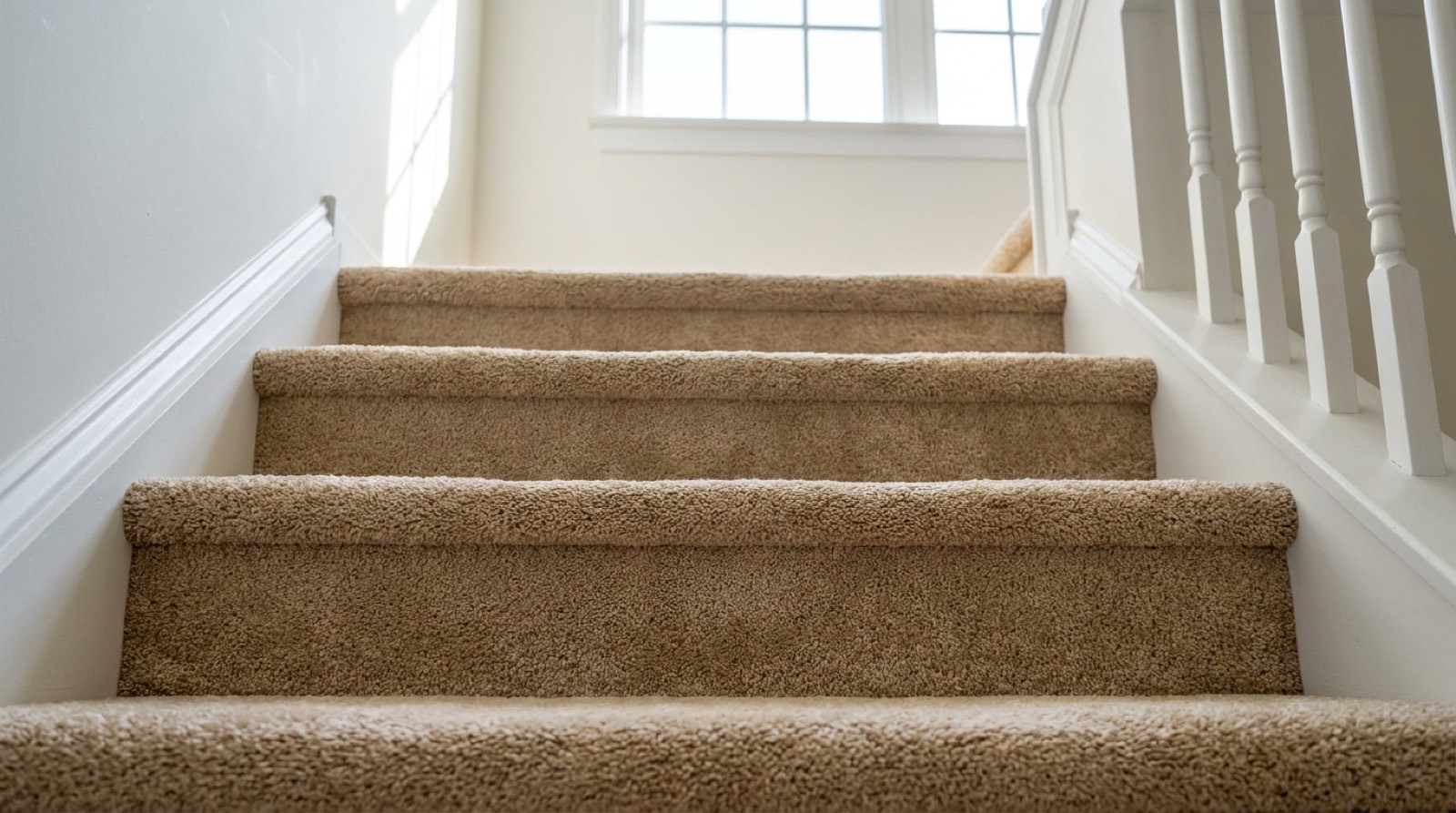
The short answer on stair carpet
Quick answer
For DMV stairs, use a low-pile, high-density cut-pile carpet in solution-dyed nylon, over a firm, thin pad (around 7/16 inch at 8-pound density). Nylon takes the abrasion that stairs dish out, a dense low pile resists crushing on the nose of each step, and a firm thin pad keeps the carpet from wearing through at the edge and keeps the stair safe underfoot. Stairs get the most concentrated foot traffic of any surface in the house, so the carpet and pad choices that are fine in a bedroom are the wrong call on a staircase.
Carpet on stairs is its own problem. Every trip up and down the house lands on the same narrow strip of carpet at the front edge of each tread, so a stair wears five to ten times faster than the open floor a few feet away. Pick the carpet and pad for that reality and a staircase lasts as long as the rest of the floor. Pick a soft plush and a thick pad because they felt nice in the showroom, and the nose of every step is matted and bald in a couple of years. This guide walks the actual decisions, fiber, pile, padding, install method, and what it costs, the way we lay them out on a DMV quote.
Why stairs are the hardest place to carpet
Quick answer
Stairs concentrate all the traffic in the house onto the nose of each tread, hit it at an angle instead of flat, and bend the carpet 90 degrees over a hard edge. That combination of abrasion, crushing, and a sharp bend is why a stair fails first. It is also why fiber resilience and pad firmness matter more on a stair than anywhere else.
Three things make a staircase brutal on carpet. First, traffic is funneled: a hallway spreads footsteps across its whole width, but a stair forces every step onto the same line at the front of each tread. Second, the load is angled and pivoting, not a flat press, so it grinds the fibers rather than just compressing them. Third, the carpet is wrapped over a hard square nose, which puts the pile under tension exactly where it gets hit hardest. Get the fiber and pad right and the stair handles it. Get them wrong and the nose of each step crushes flat, then wears through to the backing.
Best carpet fiber for stairs
Quick answer
Nylon is the best fiber for stairs because it is the most resilient, it springs back after being crushed, and it resists the abrasion stairs deliver. Solution-dyed nylon adds strong stain and fade resistance. Polyester (PET) and olefin feel soft and cost less, but they crush and mat on a staircase and should be avoided there. If budget allows, wool is excellent but premium; for nearly every DMV staircase, solution-dyed nylon is the right answer.
| Fiber | On stairs | Notes |
|---|---|---|
| Nylon (solution-dyed) | Best choice | Most resilient, springs back, abrasion and stain resistant |
| Wool | Excellent, premium | Naturally resilient and beautiful; highest cost |
| Triexta (SmartStrand) | Workable | Good stain resistance, decent resilience; midrange |
| Polyester (PET) | Avoid on stairs | Soft and cheap, but crushes and mats at the nose |
| Olefin (polypropylene) | Avoid on stairs | Stain resistant but low resilience; flattens fast |
The honest installer note: polyester is everywhere right now because it is cheap and feels plush in the store. In a low-traffic bedroom it is fine. On a staircase it is the single most common reason we get called back to recarpet stairs that are only a few years old, because the nose of each step crushes and never recovers. Spend the small upcharge for nylon on stairs even if you run polyester elsewhere. If you are weighing carpet against a hard surface on the steps, our best flooring for stairs guide covers the wood and LVP options too.
Pile style and density that hold up
Quick answer
Choose a low-pile, high-density cut pile, ideally a textured "twist" or frieze, which hides traffic and footprints. Avoid deep, soft plush (it crushes and shows every footprint on a stair) and be careful with Berber loop, because a snagged loop can "run" a line up the stairs when a pet claw or heel catches it. Density matters more than thickness: pack the tufts tight and the nose of each step holds its shape.
For carpet, density beats height every time on a staircase. A short, dense, tightly twisted pile gives footsteps nothing to flatten, while a tall soft pile just folds over. Textured cut pile and frieze (the longer, kinked twist) also scatter light so they hide the traffic lane and footprints that a smooth plush puts on display. Berber and other loop carpets can work on stairs and they wear well, but the wrapped nose stretches the loops, and a single loop snagged by a dog's nail or a stiletto can pull a visible run up several steps. If you want a loop look on a staircase with pets, a small-tight-loop or a cut-loop pattern is safer than a big chunky Berber. The "berber vs plush" question really comes down to this: on stairs, both extremes have a failure mode, and a dense textured cut pile in between is the reliable pick.
⚠ Watch out
A soft, thick plush stair carpet that looked luxurious in the showroom is the classic DMV regret. Within two winters the nose of every step is matted flat and a shade darker than the risers, because plush has no resilience and stairs hammer the same line over and over. If you love the soft feel, put it in the bedrooms and run a dense low-pile nylon on the stairs.
Padding for stairs: the firm-thin rule
Quick answer
Stairs need a firm, thin pad, around 3/8 to 7/16 inch thick at about 8-pound density. This is the opposite of a bedroom, where a thick soft pad feels great. A thick soft pad on stairs is both a wear problem (the carpet flexes too much over the nose and grinds itself out) and a safety problem (the step feels mushy and unstable underfoot). Getting the pad right on stairs matters as much as the carpet.
This is the detail homeowners get wrong most often, usually because a salesperson sold the same plush 1/2-inch pad for the whole house. On a flat floor a soft thick pad is comfortable and extends carpet life. On a staircase the same pad is a liability. The carpet has to wrap tightly over the square nose of each tread, and a thick soft pad lets it shift and over-flex right at that edge, which wears the carpet through faster and makes the step feel spongy and unsafe, especially for kids and older adults. We spec a firm, dense, thinner pad on stairs every time, even when the bedrooms upstairs get a plusher one. It is a small material difference and it is the difference between a staircase that wears evenly and one that fails at the nose. Our full carpet padding guide breaks down density, thickness, and the warranty rule for every room.
Waterfall vs cap-and-band install
Quick answer
Waterfall install runs the carpet straight over the nose and down to the next tread, which is faster and cheaper and works well on closed (walled) staircases. Cap-and-band (also called upholstered or French cap) wraps the carpet tightly around each nose and tucks it under, giving a tailored, contoured look that suits open-sided staircases and higher-end jobs. Both are solid when done right; the choice is look and budget, plus whether the stairs are open on a side.
| Method | Look | Best for | Labor |
|---|---|---|---|
| Waterfall | Carpet drapes straight over each nose | Closed staircases, value jobs, rentals | Lower |
| Cap-and-band (upholstered) | Carpet wraps and contours to each step | Open-sided stairs, tailored or high-end look | Higher |
Mechanically both methods use tackless strips in the crotch of each step plus staples to hold the carpet tight, so durability is similar when the install is good. The difference is the finished edge. Waterfall is clean and quick and is what most closed-in DMV townhome stairs get. Cap-and-band hugs the contour of each step and looks more custom, which is why it is the pick when a staircase is open on one side and the steps are on display from the foyer. It takes more labor and more skill to do cap-and-band cleanly, and it is one of the places where a real in-house crew shows up versus a rushed subcontractor. On a runner over wood, the band style is also what gives that tailored, tucked look down each side.
Stair runner vs full carpet
Quick answer
Full carpet covers the whole tread and riser wall to wall and hides the stair structure. A runner is a narrower band of carpet down the center that leaves finished wood showing on each side. Run a runner only when the stair stringers and the exposed wood are finished and worth showing; use full carpet when the stairs are unfinished or you want the warmest, quietest result. Runners cost less in material but often more in finish work on the exposed wood.
The runner-versus-full decision is really a question about what is under the carpet. If your staircase is builder-grade pine or unfinished treads, full carpet is the straightforward, cost-effective answer and it gives you the most sound dampening, which matters in a townhome. If you have, or are willing to finish, attractive hardwood treads, a runner down the middle gives you the best of both: warmth and grip in the walk zone, plus the look of real wood on the edges. Just budget for the wood: a runner exposes the sides, so any treads that were hidden under old full carpet may need sanding and finishing before the runner goes down. If you are thinking about going all the way to wood, our hardwood stairs cost guide breaks that path down.
DMV stair realities (townhomes, split-levels, basements)
Quick answer
DMV three-level townhomes typically have two full carpeted stair runs, so they carry roughly double the stair carpet of a single-flight home and benefit most from a durable nylon and good sound-dampening. Split-levels have short half-flights that wear concentrated; basement stairs are often the steepest and oldest and need the firm pad most. The house type changes how much stair carpet you have and which problems show up first.
Stairs are where the DMV's housing stock really shows up. The three-level townhomes all over Reston, Ashburn, Centreville, and Woodbridge usually have two carpeted runs (entry-to-main and main-to-bedrooms), which is a lot of stair surface and a lot of daily traffic, so the nylon-and-firm-pad combination pays off twice. Carpet on those townhome stairs also does real work damping footstep noise between levels, which a hard surface does not. The 1960s-80s split-levels in Vienna, Annandale, and Springfield have short half-flights that take very concentrated traffic, so they wear at the nose fast and reward a dense low pile. And basement stairs across the region tend to be the steepest, oldest, and least even, which is exactly where a firm, thin pad and a careful install matter for safety, not just wear. If your basement stairs are part of a finished-basement project, see our DMV basement flooring guide.
What carpet on stairs costs in the DMV
Quick answer
Our carpet is $3.25 per square foot all-in, which covers material, padding, professional installation, and removal of the old carpet. Stairs carry more labor per square foot than a flat floor because each step is wrapped, stapled, and tucked by hand, so a staircase is quoted with that detail accounted for. A standard flight of 13 to 14 steps uses roughly 40 to 50 square feet of carpet. The exact number comes from a free in-home measure, because step count and whether you want waterfall or cap-and-band move it.
| Item | How we price it | Notes |
|---|---|---|
| Carpet (all-in) | $3.25/sqft | Material + padding + installation + old-carpet removal |
| A standard flight (13-14 steps) | ~40-50 sqft of carpet | Each box step uses roughly 3 to 3.5 sqft |
| Stair labor | Built into the quote | Stairs are hand-wrapped and stapled, more labor than flat floor |
| Cap-and-band upgrade | By the job | More labor than waterfall; tailored look on open stairs |
Carpet is the most affordable flooring we install, and stairs are a small-square-footage, high-labor part of any carpet job, so the smart way to read a stair quote is on the labor and the finish, not just the price per yard of carpet. Our pricing is all-in: the quote includes the carpet, the pad, professional installation by our in-house crew with no subcontractors, and hauling away your old carpet, with no surprise line items at the end. That last part matters on stairs, because a low headline price that then adds "stair charge per step," "pad," and "haul-away" is exactly the kind of quote trap we built our pricing to avoid. The full breakdown is in our carpet installation cost guide, and the line-item traps to watch for are in our DMV hidden-charges guide.
Stair carpet mistakes we get called to fix
Quick answer
The stair-carpet redos we get called for are almost always one of five things: a soft plush or polyester that crushed flat at the nose, a thick soft pad that made the steps mushy and wore the carpet through, a chunky Berber that snagged and ran, a loose or rippling install where the staples or tackless strips let go, and a builder-grade carpet that was never rated for stairs in the first place. Every one is a material or install decision, not bad luck.
The pattern is consistent. The big one is the wrong carpet: a soft plush or a budget polyester that looked great in the showroom and flattened on the stairs within a couple of years. Second is the pad, a thick soft pad carried over from the bedrooms that makes the steps feel unstable and grinds the carpet out at the edge. Third is a big loose Berber loop that caught a claw or a heel and ran a visible line up the flight. Fourth is install: stairs that ripple, shift, or pull away from the nose because the tackless strips and staples were not set tight, which is both ugly and a trip hazard. Fifth is simply builder-grade carpet that was never spec'd for traffic. Choose a dense nylon, a firm thin pad, and a crew that wraps each step tight, and none of these show up.
FAQs about carpet on stairs
What is the best carpet for stairs?
A low-pile, high-density cut-pile carpet in solution-dyed nylon. Nylon is the most resilient fiber, so it springs back from the constant crushing stairs deliver, and a dense low pile holds its shape on the nose of each step. Add stain resistance and it lasts as long as the rest of your floors.
Should stairs use the same padding as the rest of the house?
No. Stairs need a firmer, thinner pad (around 3/8 to 7/16 inch at 8-pound density), even if the bedrooms get a thicker, softer one. A thick soft pad on stairs feels mushy and unsafe and wears the carpet through faster at the edge.
Is Berber carpet good for stairs?
It can work and it wears well, but a chunky Berber loop has a real risk on stairs: a pet claw or a heel can snag a loop and run a visible line up the flight. If you want a loop look on stairs, choose a small tight loop or a cut-loop pattern instead of a big Berber.
What is the difference between a waterfall and a cap-and-band stair install?
Waterfall runs the carpet straight over the nose to the next step, which is faster and cheaper and suits closed staircases. Cap-and-band wraps the carpet tightly around each nose and tucks it under for a tailored, contoured look, which suits open-sided and higher-end stairs.
How much carpet does a flight of stairs need?
A standard flight of 13 to 14 box steps uses roughly 40 to 50 square feet of carpet, since each step (tread plus riser) takes about 3 to 3.5 square feet. Step count, landings, and whether the stairs are open on a side change the total.
Can you put a runner over carpeted stairs?
Not over existing carpet. A runner goes over finished wood treads, so if your stairs are currently full-carpeted, the treads underneath usually need to be sanded and finished first. Once the wood is finished, a runner gives you grip and warmth in the center with real wood showing on the sides.
Bottom line: how to pick stair carpet
Stairs take the most concentrated abuse of any surface in your home, so the carpet that is fine in a bedroom is the wrong call on the steps. Pick a low-pile, high-density cut pile in solution-dyed nylon, put it over a firm, thin pad, and have it wrapped tight to each nose by a crew that does stairs by hand. That combination wears evenly, feels safe underfoot, and lasts. The plush-and-thick-pad shortcut is what turns a staircase bald at the nose in two years.
We carpet stairs across the DMV, and every quote is all-in: the carpet, the pad, professional installation by our in-house crew with no subcontractors, and removal of your old carpet, with no surprise per-step line items at the end. If you want a straight answer on the right carpet for your stairs, or whether a runner over finished wood makes more sense for your house, request a free estimate or call us at 571-341-7247 and we will measure the stairs and walk you through the options. The full service is on our carpet page.