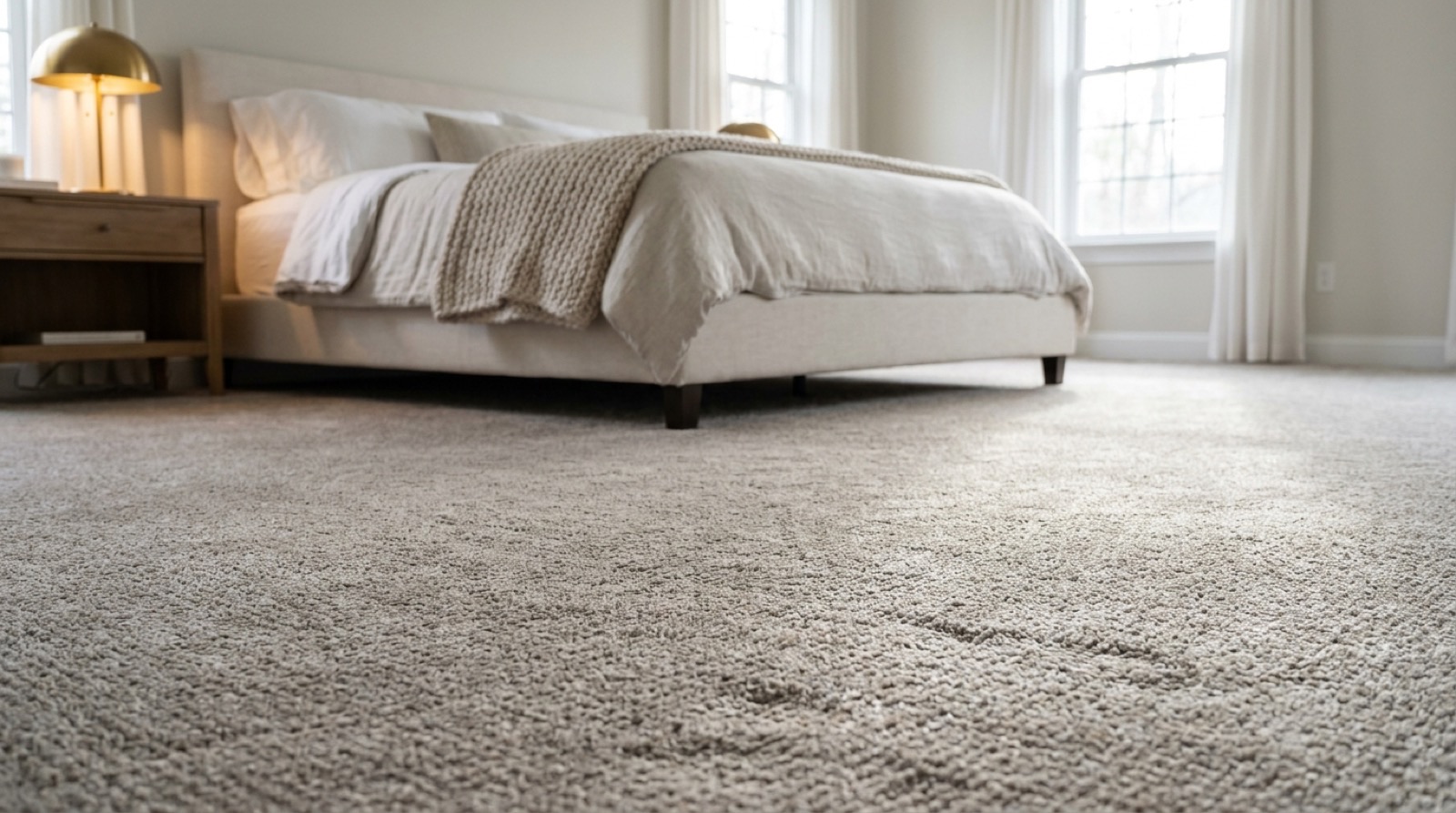
The short answer on bedroom carpet
Quick answer
A bedroom is a low-traffic room, so you can chase softness here in a way you never should on stairs or in a hallway. For most DMV bedrooms, a soft nylon or Triexta cut pile in a plush or textured style, over a thick, softer pad (around 7/16 to 1/2 inch at 6 to 8 pound density), is the sweet spot: comfortable underfoot, quiet, and durable enough for a room nobody walks through all day. Save the tougher, cheaper choices for guest rooms and the pricier wool or premium nylon for the primary bedroom you actually live in.
Bedroom carpet is the one place in the house where comfort gets to win. A staircase forces every step onto the nose of each tread, so it demands a dense, tough fiber and a firm pad. A bedroom is the opposite: you walk a few steps to the bed and the closet, and the rest of the floor barely gets touched. That means the plush, sink-in feel that would fail on stairs is exactly right here. This guide walks the real decisions, fiber, pile, padding, which room gets what, and what it costs, the way we lay them out on a DMV quote.
Why bedroom carpet is a different choice than the rest of the house
Quick answer
Bedrooms see a fraction of the foot traffic that stairs, hallways, and living rooms get, so durability stops being the deciding factor and comfort takes over. You can pick a softer fiber, a taller plush pile, and a thicker pad than you would anywhere else in the house, and it will still last, because nothing is grinding it down all day. The mistake is buying bedroom carpet by the same rules you would use for a stair.
Think of your floors in traffic tiers. Stairs and main hallways take the whole household's traffic funneled onto a narrow path, so they need dense, resilient fiber and a firm pad (we cover that in the best carpet for stairs guide). Living rooms and family rooms are middle tier. Bedrooms sit at the bottom: a primary bedroom might see two people crossing a short path morning and night, and a guest room sees almost nothing for weeks at a time. Because of that, the whole decision flips. On a stair you spend your money on toughness. In a bedroom you spend it on feel, warmth, and quiet, and you can relax the durability spec without regretting it in two years.
Best carpet fiber for a bedroom
Quick answer
Nylon and Triexta (SmartStrand) are the best all-around bedroom fibers: soft, resilient, and stain resistant, with Triexta giving the best built-in stain protection for kids' and pets' rooms. Polyester (PET) is genuinely fine in a low-traffic bedroom, where its softness is an asset and its weaker resilience never gets tested. Wool is the premium option for a primary bedroom if the budget is there. Unlike stairs, where polyester crushes and fails, a bedroom is the one room where the soft, cheaper fiber is a defensible pick.
| Fiber | In a bedroom | Notes |
|---|---|---|
| Nylon (solution-dyed) | Best all-around | Soft, resilient, stain and fade resistant; safe in any bedroom |
| Triexta (SmartStrand) | Best for kids and pets | Permanent built-in stain resistance, very soft, strong value |
| Polyester (PET) | Fine here | Exceptionally soft and affordable; low traffic hides its weaker resilience |
| Wool | Premium primary bedroom | Naturally soft, warm, and beautiful; highest cost |
| Olefin (polypropylene) | Skip in bedrooms | Flattens and holds odor; better suited to Berber in low-moisture areas |
Here is the honest installer note, and it is the opposite of what we tell people about stairs. Polyester gets a bad rap because it fails in high-traffic areas, and that reputation is deserved on a staircase. But a bedroom is where polyester actually belongs: it is the softest fiber at the sample rack, it resists stains well, it costs less, and in a room that sees almost no traffic its weaker resilience never becomes a problem. So if the budget is tight, a plush polyester in a guest room or a spare bedroom is a smart spend, not a corner cut. Put the extra money into nylon or Triexta in the rooms that get daily use, and into wool in the primary if you love the feel. When durability matters more than softness, our pet-friendly flooring guide covers the fiber and warranty details for homes with dogs and cats.
Pile, density, and how soft you can go
Quick answer
For a bedroom you can run a taller, softer pile than anywhere else. A plush (Saxony) cut pile gives the classic velvety, sink-in feel; a textured or frieze twist gives nearly the same softness while hiding footprints and vacuum marks. Density still matters for how long it looks new, so check the face weight and the tuft density on the sample rather than just how thick it feels. Softness is the goal here; density is how you keep that softness looking good for years.
In a bedroom, pile height is a comfort decision, not a survival decision. A deep, soft plush that would mat flat on a stair in two winters can live happily in a primary bedroom for a decade because nothing pounds it. If you want that hotel-suite feel, a plush Saxony delivers it. The one tradeoff is that smooth plush shows every footprint and vacuum line, which some people love and some find fussy. If that bugs you, a textured cut pile or a frieze (the longer, kinked twist) keeps most of the softness while scattering light so the room never looks tracked-up. The buying signal that actually predicts how long carpet stays nice is density, meaning how tightly the tufts are packed, and face weight, meaning how many ounces of fiber per square yard. Press your thumb into the sample and bend it back: if the backing grins through easily, it is loosely packed and will crush sooner. Tightly packed, harder to spread, means it will hold its look longer, even in a soft pile.
Padding for bedrooms: the thick-soft rule
Quick answer
Bedrooms are the place for a thicker, softer pad, around 7/16 to 1/2 inch at 6 to 8 pound density. This is the exact opposite of the firm, thin pad stairs need. A good pad in a bedroom makes the carpet feel plush, keeps it quiet, and extends its life by absorbing impact, and because the room is low traffic there is no downside to going soft. The pad is half of how the finished floor feels, so do not let a salesperson pair nice carpet with a cheap pad.
This is the clearest reversal from the stairs rule, and it is worth stating plainly because homeowners get whiplash from it. On a staircase, a thick soft pad is a wear and safety problem, so we spec a firm, thin one. In a bedroom, a thick soft pad is exactly what you want: it gives the floor that sink-in feel, it dampens sound between levels in a townhome, and it cushions the carpet so the fibers last longer. The only limit is the carpet manufacturer's spec, since most residential cut-pile warranties cap the pad at 1/2 inch and require a minimum density (commonly 6 pound) to stay valid. A pad that is too thick or too soft can actually void the warranty and let the carpet flex too much, so thicker is not automatically better past that line (our carpet padding guide covers the density and warranty rules in full). For a bedroom, a quality 7/16 inch rebond at 6 to 8 pound density hits the comfort target and keeps the warranty intact. One exception, covered below, is a below-grade basement bedroom, where the pad choice changes for moisture reasons.
Match the carpet to the room
Quick answer
Do not buy the same carpet for every bedroom. Put your best fiber and softest pile in the primary bedroom you use daily, a tough stain-resistant Triexta or nylon in kids' and teens' rooms, and an affordable soft polyester in guest rooms that sit empty most of the year. Basement bedrooms get a moisture-barrier pad and a synthetic fiber, never wool. Matching the spend to how each room actually gets used is where you save money without regret.
| Room | Best pick | Why |
|---|---|---|
| Primary bedroom | Soft nylon, Triexta, or wool; plush or textured | Daily use, so spend on feel and longevity you will notice |
| Kids' / teens' room | Triexta or solution-dyed nylon, textured | Spills, pets, and traffic; built-in stain resistance earns its keep |
| Guest room | Plush polyester (PET) | Near-zero traffic; soft and affordable is the smart spend |
| Basement bedroom | Synthetic fiber + moisture-barrier pad | Below-grade moisture; never wool, never an organic pad |
The single biggest way to waste money on bedroom carpet is buying one grade for the whole upstairs. The primary bedroom and a guest room have completely different jobs, so they deserve different carpet. Spend where you feel it every day, which is the room you sleep in, and pull back where you will not, which is the spare room your in-laws use twice a year. Kids' and teens' rooms are their own case: they get the spills and the pet accidents, so a Triexta or a solution-dyed nylon with a real stain warranty pays for itself the first time a juice cup tips over. And a basement bedroom is not really a bedroom question at all, it is a moisture question, which is the next section.
DMV bedroom realities and low-VOC health
Quick answer
Below-grade basement bedrooms across the DMV need a synthetic fiber and a moisture-barrier pad, because concrete slabs wick humidity that rots organic pads and grows mildew under wool. Older Alexandria and Arlington homes often have squeaky or uneven subfloors worth screwing down before carpet goes over them. And because you breathe bedroom air for eight hours a night, ask for low-VOC carpet and pad carrying the CRI Green Label Plus mark. The room you sleep in is the one place the air-quality spec genuinely matters.
Bedrooms bring a few DMV-specific wrinkles. First, basements: a huge share of the region's finished basements include a bedroom or a bonus sleeping room, and those sit on a concrete slab that stays cool and damp. Wool and organic jute pads are a mistake there, because they hold moisture and grow mildew. The right build is a synthetic carpet over a rubber or moisture-barrier pad that keeps slab humidity off the fiber, and if the slab has ever shown dampness, that gets addressed first. Our DMV basement flooring guide goes deeper on when carpet is even the right call below grade versus LVP. Second, the older housing stock: colonials and Cape Cods in Alexandria, Arlington, and Falls Church often have plank subfloors that have loosened over decades, and the quiet moment before carpet goes down is the time to screw those down so your new bedroom floor does not squeak. Third, and specific to bedrooms, is air quality. New carpet can off-gas for the first days after install, and a bedroom is where you spend a third of your day with the door closed. Asking for carpet and pad that carry the Carpet and Rug Institute's Green Label Plus certification keeps the VOCs low, and airing the room out for a day or two after install clears the new-carpet smell faster.
What bedroom carpet costs in the DMV
Quick answer
Our carpet is $3.25 per square foot all-in, which covers material, padding, professional installation, and removal of the old carpet. A typical 12 by 14 foot DMV bedroom is about 168 square feet, and a larger 14 by 16 primary runs about 224 square feet, so most single bedrooms land in a clear, predictable range at that all-in price. Upgrading the fiber to a premium nylon or wool moves it, and the exact number comes from a free in-home measure.
| Bedroom size | Approx. square feet | How we price it |
|---|---|---|
| Small / guest (10 x 11) | ~110 sqft | $3.25/sqft all-in |
| Standard bedroom (12 x 14) | ~168 sqft | $3.25/sqft all-in |
| Primary bedroom (14 x 16) | ~224 sqft | $3.25/sqft all-in |
| Whole upstairs (3-4 bedrooms) | Measured together | $3.25/sqft all-in; one measure, one number |
Carpet is the most affordable flooring we install, and a bedroom is a simple, open rectangle, so it is one of the most predictable jobs to price. Our number is all-in: the quote includes the carpet, the pad, professional installation by our in-house crew with no subcontractors, and hauling away your old carpet, with no surprise line items at the end. That matters because the big-box trap is a low headline price per square foot that then adds pad, installation, furniture moving, and old-carpet haul-away as separate charges, so the real total lands far above the sticker. The full breakdown is in our carpet installation cost guide, and the exact line items to watch for on any quote are in our DMV hidden-charges guide. If you are weighing carpet against a hard surface in the bedroom, our carpet-to-hardwood cost comparison lays out that math, and if the hard surface is vinyl plank specifically, our carpet vs vinyl plank guide covers it room by room.
Bedroom carpet mistakes we get called to fix
Quick answer
The bedroom carpet regrets we get called for are almost always one of four things: pairing nice carpet with a cheap thin pad so it feels flat, buying the same grade for every room instead of matching spend to use, putting wool or an organic pad in a below-grade basement bedroom, and skipping the subfloor fix so a brand-new floor squeaks. Every one is a spec decision made at the quote, not bad luck.
The pattern is consistent. The most common one is the pad: someone spends real money on soft carpet and then lets it get paired with the thinnest cheapest pad to save a little, and the finished floor feels hard and wears faster. In a bedroom the pad is where comfort comes from, so it is the last place to cut. Second is buying one carpet for the whole upstairs, which either overspends on guest rooms or underspends on the primary, when matching the grade to each room's use saves money and feels better. Third is the basement bedroom built with wool or an organic pad over a damp slab, which grows mildew and smells within a year. Fourth is the squeak: carpet went over a loose old subfloor that nobody screwed down first, so the new floor announces every step. Get the pad right, match the room, respect the slab, and fix the subfloor, and none of these show up.
⚠ Watch out
The classic bedroom mistake is falling for a gorgeous soft carpet and then accepting whatever pad is cheapest to keep the number down. The carpet feels amazing in the showroom because it is stapled over a thick pad on the display, then feels flat and hard in your bedroom over a thin one. Spec the pad and the carpet together, because in a low-traffic room the pad is doing half the work of how the floor feels.
FAQs about bedroom carpet
What is the best carpet for a bedroom?
A soft nylon or Triexta cut pile in a plush or textured style, over a thick, comfortable pad. Because a bedroom is low traffic, you can prioritize softness over toughness. Triexta adds the best built-in stain resistance for kids' and pets' rooms, and wool is the premium option for a primary bedroom.
Is polyester carpet good for bedrooms?
Yes, in a bedroom polyester is a smart pick. It is the softest fiber at the sample rack, resists stains well, and costs less. Its weakness is resilience under heavy traffic, which a low-traffic bedroom never tests. Save it for guest and spare rooms, and use nylon or Triexta in daily-use bedrooms.
What thickness carpet pad is best for a bedroom?
Around 7/16 to 1/2 inch at 6 to 8 pound density. This is thicker and softer than a stair pad, and it gives the bedroom its plush, quiet feel while extending carpet life. Most residential warranties cap the pad at 1/2 inch and require a minimum density, so thicker is not always better past that line.
Should I put carpet in a basement bedroom?
You can, but build it for moisture. Use a synthetic fiber and a rubber or moisture-barrier pad, never wool or an organic pad, because a concrete slab wicks humidity that grows mildew. If the slab has ever shown dampness, address that first, or consider LVP instead.
Does new bedroom carpet off-gas, and is it safe?
New carpet can release low levels of VOCs for the first few days. Because you sleep in the room, ask for carpet and pad carrying the CRI Green Label Plus certification, which limits emissions, and air the room out for a day or two after install to clear the new-carpet smell faster.
How much does it cost to carpet a bedroom in the DMV?
Our carpet is $3.25 per square foot all-in, covering material, pad, installation, and old-carpet removal. A standard 12 by 14 bedroom is about 168 square feet and a larger primary about 224, so most single bedrooms price out in a clear, predictable range. A free in-home measure gives the exact number.
Bottom line: how to pick bedroom carpet
A bedroom is the one room where comfort gets to win, so throw out the stair rulebook. Pick a soft nylon or Triexta cut pile (or wool if the budget is there), run a taller plush or textured pile than you would anywhere else, and put it over a thick, softer pad. Match the grade to the room, spending on the primary you use daily and pulling back on the guest room. Watch the two things that actually matter in the DMV: build a basement bedroom for moisture, and ask for low-VOC materials in the room you breathe in all night.
We carpet bedrooms across the DMV, and every quote is all-in: the carpet, the pad, professional installation by our in-house crew with no subcontractors, and removal of your old carpet, with no surprise line items at the end. If you want a straight answer on the right carpet and pad for your bedrooms, or whether a below-grade room should be carpet or LVP, request a free estimate or call us at 571-341-7247 and we will measure the rooms and walk you through the options. The full service is on our carpet page.