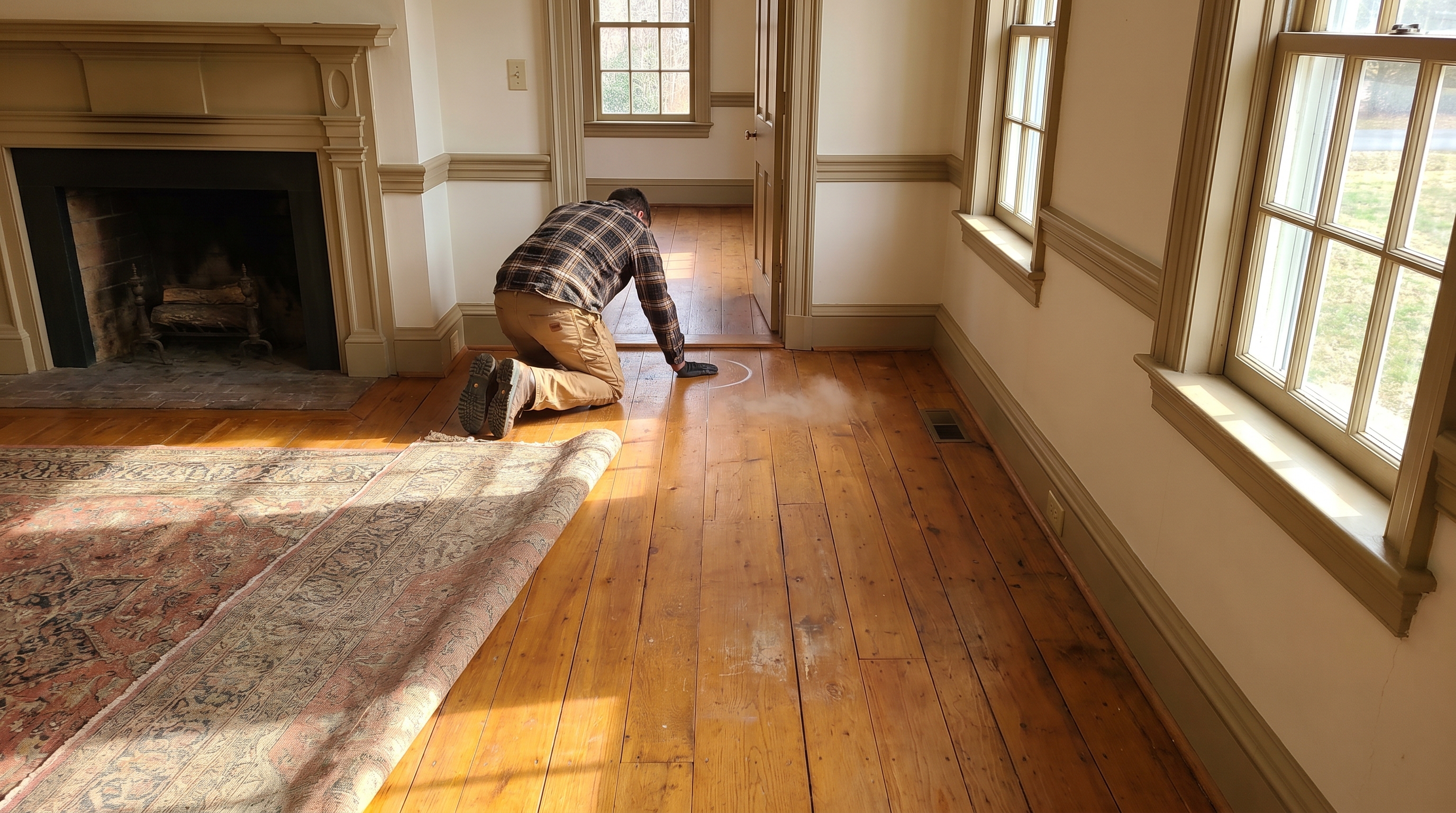
Every DMV homeowner with a wood floor has the same Tuesday-night experience: the house goes quiet after the kids are down, you walk back to the kitchen, and one specific spot in the hallway squeaks like a haunted-house sound effect. The squeak has been there for two years. You step around it. Then you step around it. Then one day you finally Google "how to fix squeaky hardwood floors" and get fifteen articles telling you to sprinkle baby powder on it. Half the time that works for a week. Half the time it does nothing. Nobody tells you why. After 20+ years of fixing squeaky floors across Alexandria, Arlington, Falls Church, Fairfax, Bethesda, and the rest of the DMV metro, this is the actual diagnostic protocol. Figure out which of the three real causes you have, then match the fix to the cause. Real 2026 DMV pricing for every option, the methods that hold up over time, and the two situations where we honestly tell homeowners to skip spot-fixing and refinish the floor instead.
The short answer for DMV homeowners
Quick answer
Diagnose the squeak first, then pick the fix. Tight high-pitched squeak when you shift weight = board-on-board friction (boards rubbing each other at the tongue-and-groove). Fix with talc, baby powder, or powdered graphite worked into the seam. Free, takes 10 minutes. A vertical creak when a board flexes underfoot = the board has lifted off the subfloor nail. Fix from above with a Counter-Snap trim screw ($25 kit) on exposed hardwood, or Squeeeeek-No-More ($25 kit) through carpet. A deep groan that vibrates the floor when you walk past = the subfloor itself has lifted off a joist. Fix from below if the basement ceiling is open (shim + construction adhesive, $80 supplies), or from above with a screw through the subfloor into the joist if it isn't. Professional DMV repair visit: $250-$600 for 1-5 squeaks. Refinish the whole floor instead if more than 10 squeaks in 200 sqft. At that point the boards or fasteners are systemically loose and spot-fixing produces a patchwork.
That is the head answer. The body of this guide is the diagnostic: three squeak sounds, three causes, five fix paths. Get the diagnostic right and the cheapest fix usually works on the first try.
The 3 real causes of a hardwood squeak (and the 30-second diagnostic)
Quick answer
Wood floors squeak from one of three mechanical failures. (1) Board-on-board friction at the tongue-and-groove joint, which sounds like a high tight chirp when you rock weight side-to-side. (2) Board-on-subfloor lift, where a fastener has backed out and the plank flexes off the subfloor, which sounds like a single vertical creak when you step straight down. (3) Subfloor-on-joist gap, where the entire subfloor sheet has lifted off the framing, which sounds like a deep groan and you feel the floor flex over a 2-3 foot area. The diagnostic takes 30 seconds: stand on the squeak, rock your weight side-to-side, then straight down, then step around the perimeter and feel where the floor moves with you. Each cause has a different fix, and the wrong fix on the wrong cause does nothing.
Run this test before you buy anything. Walk the squeak. Listen for the sound and watch for movement.
| Sound | What you feel | Likely cause | Right fix |
|---|---|---|---|
| High tight chirp or squeak (above 1 kHz) | Sound only when you rock weight side-to-side; no vertical movement | Board-on-board friction at tongue-and-groove | Talc, baby powder, or powdered graphite into the seam |
| Single creak when you step straight down | Board visibly flexes 1/16 to 1/8 inch under your foot | Board has lifted off the subfloor fastener | Counter-Snap trim screw (exposed hardwood) or Squeeeeek-No-More (through carpet) |
| Deep groan over a 2-3 foot zone | Floor flexes across multiple boards; you feel waves | Subfloor has lifted off the joist | From below: shim + adhesive on the joist top. From above: long screw through subfloor into joist |
| Crackle that moves with footfall everywhere | Squeaks in 10+ spots across the room | Systemic fastener failure or end-of-life subfloor | Skip spot fixes. Refinish (boards reset) or replace the floor entirely |
The 30-second diagnostic is the single most useful thing on this page. Most homeowners try the powder fix on a board-on-subfloor lift, get no result, and assume their floor is hopeless. Wrong fix for the wrong cause. Powder solves friction, not lift.
💡 Key takeaway
If you can see a board move under your foot, no amount of powder will fix the squeak. The fastener has failed. You need a mechanical re-fastening from above (Counter-Snap or Squeeeeek-No-More) or from below (shim plus screw). Diagnose the movement first, then choose the method.
Why DMV homes squeak: a housing-stock cause map
Quick answer
DMV housing stock has three squeak patterns by era. Pre-1950 Alexandria, Arlington Lyon Village, Falls Church City, DC Capitol Hill, and Old Town colonials have original 3/4-inch pine subfloors fastened with cut nails into solid sawn joists. After 80 years of seasonal movement the nails loosen and the floor squeaks at the joint lines. 1960s-1990s split-levels, ranches, and townhomes in Vienna, Annandale, Springfield, and Fairfax have plywood subfloors over 2x10 dimensional lumber joists; the joists have crowned, twisted, or settled and pulled the subfloor off the framing in places. Post-2000 condos in Reston, Tysons, and DC have engineered hardwood floating or glued over a concrete slab plus sleepers, which squeaks when the underlayment compresses or the sleeper attachment fails. Different cause, different fix, different pricing.
The era of the home tells you which fix is likely to work before you buy anything. Walk it backwards from the squeak sound through the housing stock:
- Pre-1950 brick colonial or rowhouse (Old Town Alexandria, Lyon Village, Cherrydale, Cleveland Park, Georgetown, Capitol Hill, Falls Church City pre-1940): Original tongue-and-groove pine or oak strip on plank subfloor with cut nails into solid sawn joists. The squeak is almost always either (a) board-on-board at joints that have spread from 80 years of seasonal movement, or (b) cut-nail backout where a single nail has worked itself up 1/16 inch. The powder-and-graphite fix solves type (a) for 6 to 18 months. Type (b) needs a finish nail driven flush, with the head set below the surface and filled. Counter-Snap kits work but be careful. Drilling a pilot hole near an 80-year-old cut nail can split the original board if the bit angle is off. We recommend a pro on pre-1950 homes for non-trivial squeak counts.
- 1960s-1990s split-level, ranch, townhome (Vienna, Annandale, Springfield, Burke, Fairfax, McLean post-1965, Reston original, Centreville): Plywood (1/2 to 5/8 inch) subfloor over 2x10 or 2x12 dimensional joists at 16 inches on center, with the hardwood nailed or stapled through the plywood. The plywood and joists shrink and twist with seasonal humidity, and after 30 to 50 years the staples have backed out or the plywood has lifted off the joist top. Both Counter-Snap and Squeeeeek-No-More work cleanly on this housing stock. The joists are easy to locate (stud finder reads through the hardwood), and the subfloor isn't so old it splits when you drive a screw. This is the easiest DMV vintage to DIY-fix a squeak in.
- Post-2000 condo, mid-rise, or new-construction townhouse (Tysons, Reston Town Center, Ashburn, DC NoMa, Crystal City, Pentagon City, Mosaic District): Engineered hardwood over concrete slab, either floating with an attached or separate underlayment or glued direct to slab. Squeaks here are almost never the wood. They're either (a) the underlayment compressed at a high-traffic spot and the click-lock joints are now rubbing against the slab, or (b) the glue bond failed in spots and the board flexes against the substrate. Neither powder nor Counter-Snap will solve these. You need to either re-glue from below the board (rare, requires partial pull-up) or live with the squeak. Floating engineered floors over slabs are the hardest squeaks to fix in the DMV.
If you're in a pre-1950 home, factor in the cut-nail risk before you drill anything. If you're in a 1960s-90s plywood-on-joist build, DIY fixes have the highest success rate. If you're in a post-2000 slab condo, set expectations low. The structural reality limits what any fix can do. See our subfloor repair guide for the deeper diagnostic on what's actually happening under DMV floors when we pull the existing flooring up.
Winter squeaks vs summer squeaks: the humidity story
Quick answer
In the DMV, most hardwood squeaks are seasonal. The squeak that drives you crazy from December through March often disappears entirely in July. The mechanism: indoor relative humidity drops from 50-55 percent in summer to 20-30 percent in winter when heating is running, the wood shrinks, the tongue-and-groove joints spread, and the boards rub differently. A squeak that only shows up in winter is almost always solvable by adding a whole-house humidifier and keeping indoor RH at 35-50 percent year-round. A squeak that's there year-round is structural: fastener failure, subfloor lift, or board-level damage, and needs a real fix.
Track your squeak for two weeks before you do anything. If it gets dramatically worse in cold weather (DMV February when furnaces run and indoor RH drops below 25 percent) and gets better in May when ambient humidity climbs back into the 40s, you have a humidity-driven squeak. Whole-house humidifier installed on the HVAC plenum runs $400 to $1,200 in the DMV and solves these squeaks across the entire floor, not just the one spot you keep stepping on. It also prevents the related winter problem: gapping between boards that shows up as visible black lines across the floor.
If the squeak is year-round and consistent regardless of season, it's structural. None of the humidity stuff will help. Go to the mechanical fix sequence below. The seasonal context is also worth knowing because it tells you whether to fix in October (before the squeak gets bad) or wait until February (when you can hear it clearly and locate it). For deeper context on how DMV humidity swings affect hardwood, see our hardwood buckling and cupping guide.
Step 1 fix: powder and graphite (free, same afternoon)
Quick answer
The powder fix is the right starting point for board-on-board friction squeaks only. Sprinkle talc, baby powder, or powdered graphite generously over the squeak area, work it into the seams between boards with a stiff-bristle brush or your fingers, walk it in for 5 minutes, then vacuum up the excess. Total cost: $0 (use the baby powder under the sink) to $8 for a bottle of powdered graphite at Ace Hardware. Stays effective 3 to 18 months depending on traffic and humidity stability. Repeat as needed. Doesn't damage the finish if you vacuum the excess; the powder that's wedged in the seam stays put and quietens the rubbing surface.
The mechanism: tongue-and-groove hardwood floors squeak when adjacent boards rub against each other at the joint. Wood-on-wood friction is loud. Wood-on-powder is silent. The powder lubricates the contact surface. It's not glamorous but it works on the right cause.
Three rules for the powder fix:
- Use the right powder. Talc and baby powder are nearly identical (talcum) and both work. Powdered graphite (Ace #2154 or any locksmith section, $6 to $10) is darker and more durable but it stains light-finish floors if you don't vacuum carefully. For dark-stained floors, graphite is the best pick. For natural maple, white oak, or any blonde finish, stick with talc.
- Work it into the seam, not just on top. Sprinkle, then push the powder into the gap with a credit card, stiff brush, or your fingertip. Walk on it for 5 minutes to drive it deeper. Then vacuum the surface. The powder that stays in the seam is what's doing the work.
- Don't use WD-40 or other oils. Spray-on lubricants and silicones contaminate the wood finish and prevent any future refinish from bonding. We've had to chemically strip floors before refinishing because previous owners sprayed WD-40 into squeaks for years. Adds $1.50 to $2.50/sqft to a refinish to remove. Powder doesn't have this problem. It vacuums out cleanly.
Powder is the right first try because it's free, fast, reversible, and tells you immediately whether you have a friction squeak or a lift squeak. Powder works = friction cause = problem solved for now. Powder does nothing = lift cause = move to step 2.
Step 2 fix: Counter-Snap trim screws on exposed hardwood
Quick answer
Counter-Snap is the right DIY fix for a vertical lift squeak through exposed (uncarpeted) hardwood. The kit ($25 at Home Depot, Lowe's, or Amazon) includes a depth-control jig, replacement bits, and 25 trim screws with a snap-off head. Drill a pilot through the board into the subfloor (or into a joist if you can locate one with a stud finder), drive the screw with a regular drill, then snap off the head with the included jig. The remaining 1/4-inch head sits in a tiny pre-drilled hole below the surface; fill with matching color wood putty (DAP Plastic Wood-X in oak, walnut, cherry, or whatever your floor is, $5 at any hardware store). Done well, the repair is invisible. Total cost: $30 for the first squeak, $5 per additional squeak. Stays put permanently. The screw is now holding the board down.
The Counter-Snap kit was specifically engineered for this problem. It does three things a standard wood screw can't: (1) the depth jig stops the bit before it goes through the subfloor or hits a joist hanger, (2) the trim-head profile leaves a hole small enough to fill invisibly, and (3) the snap-off design means you don't have to plug a 3/8-inch counterbore. The original kit is by O'Berry Enterprises (now sold under several brand names including "Squeak No More for Hardwood", same kit, different sticker). Don't substitute drywall screws or generic wood screws. The heads are too big and you'll see the patch.
Three rules for Counter-Snap:
- Drill into the joist when possible. A screw into the joist (through both the hardwood and the subfloor) creates a permanent mechanical link from the squeaky board down to the framing. A screw into just the subfloor (no joist) works most of the time but can fail later if the subfloor itself lifts. Find joists with a stud finder set to "deep scan" mode. Most DMV floors over plywood will read joists at 16 inches on center running one direction across the room.
- Pilot first, every time. The kit includes the right bit and the depth stop. Don't skip the pilot. Driving a screw through an 80-year-old oak board without a pilot can split the board down the grain, and now you have a split board AND a squeak.
- Use the actual fill putty matched to your floor. DAP Plastic Wood-X in the color closest to your stain. Or Timbermate filler (sold in 25+ colors at fine woodworking shops, ~$12, best match for unusual stains). Generic "wood-tone" putty leaves a visible dot. The right color makes the fix invisible at standing height.
For homeowners who don't want to drill into their hardwood at all, the next step (Squeeeeek-No-More) works through carpet. Or you skip to the professional fix and we handle it. But for an exposed hardwood squeak, Counter-Snap is the highest-success DIY method we know of.
Step 3 fix: Squeeeeek-No-More for carpet over subfloor
Quick answer
Squeeeeek-No-More is the same engineering as Counter-Snap but designed to fix subfloor squeaks through carpet without pulling up the carpet. Kit runs $25 at any home improvement store. Includes a tripod alignment jig that protects the carpet pile, a depth-control fixture, and 50 screws. Drive screws through the carpet (the tripod parts the pile so the screw goes between fibers, not through them) into the subfloor and joist below, then snap the head off with the jig. The carpet fibers spring back over the tiny hole and the repair is invisible. Works on any padded carpet over plywood subfloor. Total cost: $25 for the first squeak, ~$5 per additional. Stays put permanently. Doesn't work on commercial loop carpet (the snap mechanism damages the loops) or on carpet over concrete slab (no joist to grab).
Carpet-over-hardwood is common in DMV homes too. A homeowner carpeted over original hardwood in the 70s or 80s and now the carpet squeaks. The Squeeeeek-No-More kit handles this too. Drive the screw through the carpet, through the hardwood, into the joist. The hardwood will have a tiny screw hole in it that you'll find later when you finally pull the carpet up to refinish the original floor. Minor cosmetic issue, easily filled at refinish time.
One pro tip: if the squeak is in carpet over a known sub-area you'll be replacing the carpet on soon (or pulling up to refinish hardwood), pull a corner of the carpet now, fix the squeak with Counter-Snap on the exposed subfloor, and roll the carpet back. The fix is cleaner and you don't need to use the more expensive carpet-specific kit. Most DMV carpet is tacked to a tack strip around the perimeter. Pulling one corner with a pair of pliers takes 5 minutes and a fresh tack-down at the end takes 10. Same fix, less specialty hardware.
Step 4 fix: shims and adhesive from below (basement crawl-up)
Quick answer
The cleanest squeak fix possible is from below, where the squeak is a subfloor-on-joist gap and the basement (or crawlspace) ceiling is open. Have a helper walk the squeak from above. From below, watch the subfloor-joist contact line. Where you see the subfloor lift off the joist when your helper steps, drive a hardwood shim (Liberty Hardware $6 pack) into the gap with a hammer until snug (NOT tight, over-driving can lift the floor and create a new squeak elsewhere), then run a bead of Liquid Nails Heavy Duty construction adhesive ($8 tube) along the shim-joist contact. Hold a brace under it for 4 hours while the adhesive sets. Total cost: $15 to $40 supplies. Stays put permanently. The fix is invisible from above because nothing on the visible floor was touched.
This is the technique a pro will use first if the basement ceiling is open or the squeak is over a crawlspace. It has three advantages over any from-above fix: no hardware visible on the finished floor, no risk to the hardwood, and it addresses the root cause (subfloor lift) rather than just adding a fastener. The catch: most DMV homes have finished basement ceilings (drywall covering the joists), and cutting into the drywall to access a single squeak is more disruptive than just doing the from-above fix. The from-below fix is the right call when:
- The basement has an unfinished ceiling (exposed joists), common in DMV 60s-80s split-levels with workshop or storage basements
- The squeak is over a crawlspace, common in pre-1950 DC and Old Town Alexandria homes
- The squeak is in a finished basement near the staircase or mechanical chase where there's already an access panel
If your basement is fully finished and you have to cut drywall to access the joist, do the from-above fix instead. The drywall patch and paint will cost more than the squeak fix saves.
Step 5 fix: when to call a pro (and what we charge)
Quick answer
Call a pro when DIY hasn't worked, when the squeak count is high (5+ in one room), or when you're in a pre-1950 home where the cut-nail risk is real. Potomac's standard squeak-fix service call in the DMV runs $250 to $600 for 1 to 5 squeaks, depending on whether we work from above (Counter-Snap, $250-$350) or have to access from below (shim + adhesive, $400-$600 including drywall cut and patch if needed). Includes diagnostic walkthrough, fix, color-matched fill on exposed hardwood, and a 1-year fix warranty (if the fixed squeak comes back inside a year, we fix it again at no charge). For 10+ squeaks across multiple rooms, we usually recommend a full refinish at $4.50/sqft all-in instead. The boards get reset during sanding and the refinish handles every squeak across the floor.
The professional fix is worth it specifically when (a) you've tried DIY and the squeak came back, (b) the squeak is in a pre-1950 home with cut nails where the DIY risk of splitting an 80-year-old board is real, (c) the squeak count is high enough that the time cost of DIY exceeds the labor cost of a pro, or (d) the squeak is in a hard-to-access location (under a heavy piece of furniture you can't move, in a stair tread, or in a hallway with delicate plaster baseboards). For a typical Alexandria, Arlington, Falls Church, Fairfax, or Bethesda single-family home with 2-5 known squeaks, our service call runs $250-$400 and takes 90 minutes start to finish.
One thing we tell DMV customers: don't pay a contractor who quotes "by the squeak" without diagnosing first. The cheap fix on a friction squeak is powder ($0). The cheap fix on a lift squeak is Counter-Snap (~$5 per squeak in materials). The labor is in showing up, not in the fix. A flat service-call rate with a per-squeak labor add is the honest pricing structure; "$200 per squeak" pricing is a contractor padding a low-cost fix.
The two situations where we tell DMV homeowners to refinish, not repair
About 1 in 4 customers who call about squeaks are better served by skipping spot fixes and going straight to a full refinish. Two situations where this is the honest answer:
Situation 1: 10+ squeaks across one room. Spot-fixing each squeak produces a patchwork of color-matched putty dots. From standing height they're invisible. Up close, especially in low raking light from a side window in the afternoon, you can see them. More importantly: if 10+ squeaks have shown up in one room, the fastener system is systemically failing. Staples or nails across the room are loosening at similar rates, and spot-fixing the loud ones now just defers the next round of squeaks 12 to 24 months. A full refinish at $4.50/sqft all-in DMV includes sanding the floor (which often reveals more loose boards we can re-fasten during prep), then 3 coats of polyurethane. The 300 sqft living room math: $1,350 for a refinish that resets every squeak vs $500-$1,200 in spot fixes that don't.
Situation 2: The finish is at end of life anyway. If your floor is dull, scratched, faded around where the rug used to sit, or showing wear-through to bare wood in traffic paths, you're at refinish time regardless of the squeaks. Spot-fixing squeaks on a worn floor is patching the holes in a worn-out shirt. Refinish gives you 15 to 25 years of fresh finish AND solves every squeak at once. Our refinishing vs replacement guide walks through the decision in detail, and the DMV refinishing cost guide has the full price breakdown.
⚠️ Watch out
Some contractors will quote spot fixes on a floor that's clearly at end-of-life because it's an easier sell ($400 vs $2,000). Six months later you call back about new squeaks. Then again. After 18 months you've spent $1,500 on repeated spot fixes and you still need a refinish. The honest installer tells you on the first visit whether spot-fixing makes sense or whether the floor is ready for a refinish. Ask for an opinion on overall floor condition before they quote the squeaks.
DIY methods that wreck your floor (and a future refinish)
Three DIY methods to avoid completely. We see all of these on customer floors and they all make a future professional refinish harder, more expensive, or both:
- WD-40 or any spray lubricant into the squeak. The silicone in WD-40 prevents polyurethane from bonding. We can't refinish a floor that's been WD-40'd without chemically stripping the contaminated area first. Adds $1.50 to $2.50 per sqft to a refinish. Use powder. Powder vacuums out cleanly and doesn't contaminate the wood.
- Drywall screws or generic wood screws driven directly through the hardwood. The bugle head on a drywall screw leaves a divot too big to fill invisibly. The black phosphate coating bleeds into the wood and stains an oval ring around the head that's visible after putty fill. Use Counter-Snap. The trim head fills cleanly.
- Construction adhesive injected through the squeak from above. The "Squeak Ender" style products that pump glue between board and subfloor look clever but the glue oozes through the joint and onto the finished surface, leaving a visible gummy ring around the repair. Even if you wipe it immediately, residue stays in the seam and yellows over months. The right adhesive fix is from below where the glue is invisible from the finished side.
For the broader list of DIY methods to avoid across all hardwood maintenance issues (scratches, refinishing prep, finish care), see our hardwood scratch repair guide and the maintenance DIY-vs-pro framework.
Real DMV pricing: DIY supplies vs pro visit vs refinish
Here's what each real fix path actually costs in 2026 across the DMV metro:
| Fix path | DIY supply cost | Professional cost (DMV) | How long it lasts |
|---|---|---|---|
| Powder or graphite (friction squeak, any count) | $0 to $10 | Not offered standalone. DIY only | 3 to 18 months (repeatable) |
| Counter-Snap on exposed hardwood (1 to 5 squeaks) | $25 for kit plus $5 putty | $250 to $400 per visit | Permanent |
| Squeeeeek-No-More through carpet (1 to 5 squeaks) | $25 for kit | $250 to $400 per visit | Permanent |
| Shim plus adhesive from below (1 to 3 squeaks, basement open) | $15 to $40 | $300 to $500 per visit | Permanent |
| From below with drywall cut + patch (finished basement) | Not practical DIY | $400 to $600 per visit | Permanent |
| Whole-house humidifier install (seasonal-only squeaks) | Not practical DIY | $400 to $1,200 installed | Decade-plus, solves multiple problems at once |
| Full sand and refinish (10+ squeaks or end-of-life finish) | Not recommended DIY | $4.50/sqft all-in DMV (Potomac pricing). 300 sqft = $1,350. 600 sqft = $2,700. | 15 to 25 years before next refinish |
| Full board replacement (single damaged board) | Not practical DIY | $300 to $800 per board | Permanent. Board is new |
Two things to know about our pricing. First, the $4.50/sqft refinish is all-in: sanding, stain (if you want a color change or refresh), 3 coats of polyurethane, dust containment, baseboards protected, walkable in 24 hours, fully cured in 7 days. Squeaks are addressed as part of the prep work. When we sand, any loose boards get re-fastened from above before stain and finish go down. Second, our service-call squeak fix is flat-rate per visit, not per-squeak. If you have 1 squeak or 5, the visit is the same range. Beyond 5, we usually recommend a refinish or revisit the whole-floor diagnostic with you on-site. More on the cost-side math at our hardwood installation cost guide, the per-square-foot pricing breakdown, and the flooring quote hidden charges piece.
FAQs about hardwood floor squeaks in Northern Virginia
Why do my hardwood floors squeak so much?
Three real mechanical causes. Board-on-board friction at the tongue-and-groove joint produces a high tight chirp when you rock weight side-to-side. A board that has lifted off the subfloor fastener produces a single creak when you step straight down. Subfloor lifted off the joist produces a deep groan over a 2-3 foot area. In the DMV, seasonal humidity is a fourth amplifier: winter heating drops indoor RH below 25 percent, wood shrinks, joints spread, and all three squeak types get worse from December through March. A whole-house humidifier solves the seasonal amplification but won't fix structural causes.
How do I stop my hardwood floors from squeaking?
Diagnose first. Rock your weight at the squeak. If it makes noise without visible movement, it's a friction squeak. Work powder or graphite into the seam, takes 10 minutes and costs nothing. If you see the board flex 1/16 to 1/8 inch under your foot, the board has lifted off the fastener. Drive a Counter-Snap trim screw through the board into the subfloor or joist, $25 kit at any hardware store. If the whole floor flexes across 2-3 feet, the subfloor has lifted off the joist. Fix from below with a shim and construction adhesive if you can access the basement ceiling, or from above with a longer screw through both subfloor and into the joist.
Does baby powder really fix squeaky hardwood floors?
Yes, on the right cause. Baby powder (talc) and powdered graphite both work on board-on-board friction squeaks because they lubricate the contact surface where adjacent boards rub at the tongue-and-groove joint. They do not work on lift squeaks where the board has separated from the subfloor. In that case the squeak is about a board flexing under load, not friction, and lubrication does nothing. Powder fixes last 3 to 18 months and can be reapplied indefinitely. The trick is working the powder into the seam (not just on top), then vacuuming the excess.
How much does it cost to fix a squeaky hardwood floor?
DIY costs $0 to $30 for the powder, Counter-Snap, or Squeeeeek-No-More kits, plus $5 in matching putty. Professional fix in the DMV runs $250 to $400 per service-call visit for 1 to 5 squeaks worked from above, or $400 to $600 if access from below is needed (especially in a finished basement requiring a drywall cut and patch). If the squeak count is 10+ across one room, we typically recommend a full refinish at $4.50/sqft all-in DMV ($1,350 for a 300 sqft living room) which resets every squeak as part of the prep work.
Can a squeaky floor be fixed without pulling up the boards?
Yes, almost every hardwood squeak can be fixed without pulling boards. The exposed-hardwood method is a Counter-Snap trim screw driven through the board into the subfloor or joist below, with the head snapped off below the surface and filled with color-matched putty. The carpet-covered subfloor method is a Squeeeeek-No-More screw driven through the carpet and into the joist; the carpet fibers spring back over the tiny hole. The from-below method (basement ceiling open) is a shim plus construction adhesive on the joist top. Board pull-up and replacement is only required when the board itself is damaged: split, gouged through, or water-rotted.
Why does my floor only squeak in winter?
Almost certainly humidity. DMV indoor relative humidity drops from 50-55 percent in summer to 20-30 percent in winter when forced-air heat runs. Wood shrinks at low RH, the tongue-and-groove joints between boards spread, and the boards rub differently against each other and against the subfloor. The squeak that drives you crazy from December through March often disappears completely in July. The fix is a whole-house humidifier on the HVAC plenum ($400 to $1,200 installed in the DMV) targeting 35 to 50 percent indoor RH year-round. It solves seasonal squeaks across the entire floor, plus the related winter problems of visible gapping between boards and dry-air discomfort.
What is the difference between Counter-Snap and Squeeeeek-No-More?
Same engineering, different application. Counter-Snap is designed for fixing squeaks through exposed hardwood. The bit and screw are sized for driving through 3/4-inch oak or pine plus 1/2-inch plywood subfloor. Squeeeeek-No-More is designed for fixing subfloor squeaks through carpet without removing the carpet. The tripod jig parts the carpet pile so the screw goes between fibers, and the kit includes a slightly different screw profile sized for carpet plus subfloor plus joist. Both kits cost about $25 and use the same snap-off head technology. Use Counter-Snap on bare hardwood, Squeeeeek-No-More on carpeted areas.
Will refinishing my hardwood floors fix the squeaks?
Often, yes, but not by the refinish itself. Sanding doesn't fix squeaks. What does fix them is the prep work a good installer does before sanding: walking the floor, identifying every loose board, and re-fastening from above with face-nails or trim screws set below the surface (which then get filled during the stain step and disappear into the finish). A floor coming up for refinish gets every squeak addressed as part of normal prep at no separate cost. If you have 10+ squeaks plus a tired finish, a refinish is almost always the right call. Every squeak solved plus 15 to 25 years of fresh finish for $4.50/sqft all-in DMV.
Are squeaky floors dangerous or a sign of structural problems?
Almost never dangerous. The vast majority of hardwood squeaks are normal aging: fasteners working loose after 30 to 80 years, seasonal humidity cycling, tongue-and-groove joints spreading. The squeak tells you nothing about structural soundness. The rare exception: if you can see the floor visibly bowing or sloping across a room, if multiple rooms have new squeaks that appeared together in the last 6 months, or if you have water staining around squeaky areas, get a structural engineer in for a one-time inspection ($300 to $500 in the DMV). That signals a joist problem or active water infiltration that needs more than a squeak fix.
How do I find which joist is under the squeak?
Use a stud finder set to deep-scan mode. Most consumer stud finders (Franklin Sensors ProSensor 710, Zircon MultiScanner) read through hardwood and find joists at 16 inches on center in DMV homes built after 1960. Mark the joist lines with painter's tape across the squeak area, then drive your Counter-Snap or Squeeeeek-No-More screw into the joist intersection point. In pre-1950 DMV homes, joists are typically 16 inches on center but sometimes 12 or 24 inches; sawn lumber joists can also be irregular widths, so verify by tapping (the joist line sounds dense and high, the bay between joists sounds hollow and low).
Bottom line: the squeak fix decision tree
The 30-second decision
Rock your weight on the squeak. Sound only, no movement = friction squeak, fix with powder. Visible board flex = lift squeak, fix with Counter-Snap (exposed hardwood) or Squeeeeek-No-More (carpet). Whole-area flex over 2-3 feet = subfloor lift, fix from below (basement open) or from above with a longer screw into the joist. Pre-1950 home or 5+ squeaks = call a pro; service call runs $250 to $600 in the DMV. 10+ squeaks or end-of-life finish = refinish the floor instead, $4.50/sqft all-in DMV resets every squeak as part of prep.
If you're in the DMV and you've tried the powder and the Counter-Snap and the squeak is still there, or you have 5+ squeaks and don't want to chase them one at a time, give us a call at 571-341-7247 or request a free estimate. We'll walk the floor, diagnose every squeak, and quote you the right fix. Usually a service call if it's spot work, or a refinish if the count is high enough to make refinishing the cheaper math. All-in pricing, no surprises, in-house crew (no subs), and the diagnostic walk-through is free whether you book the work or not.