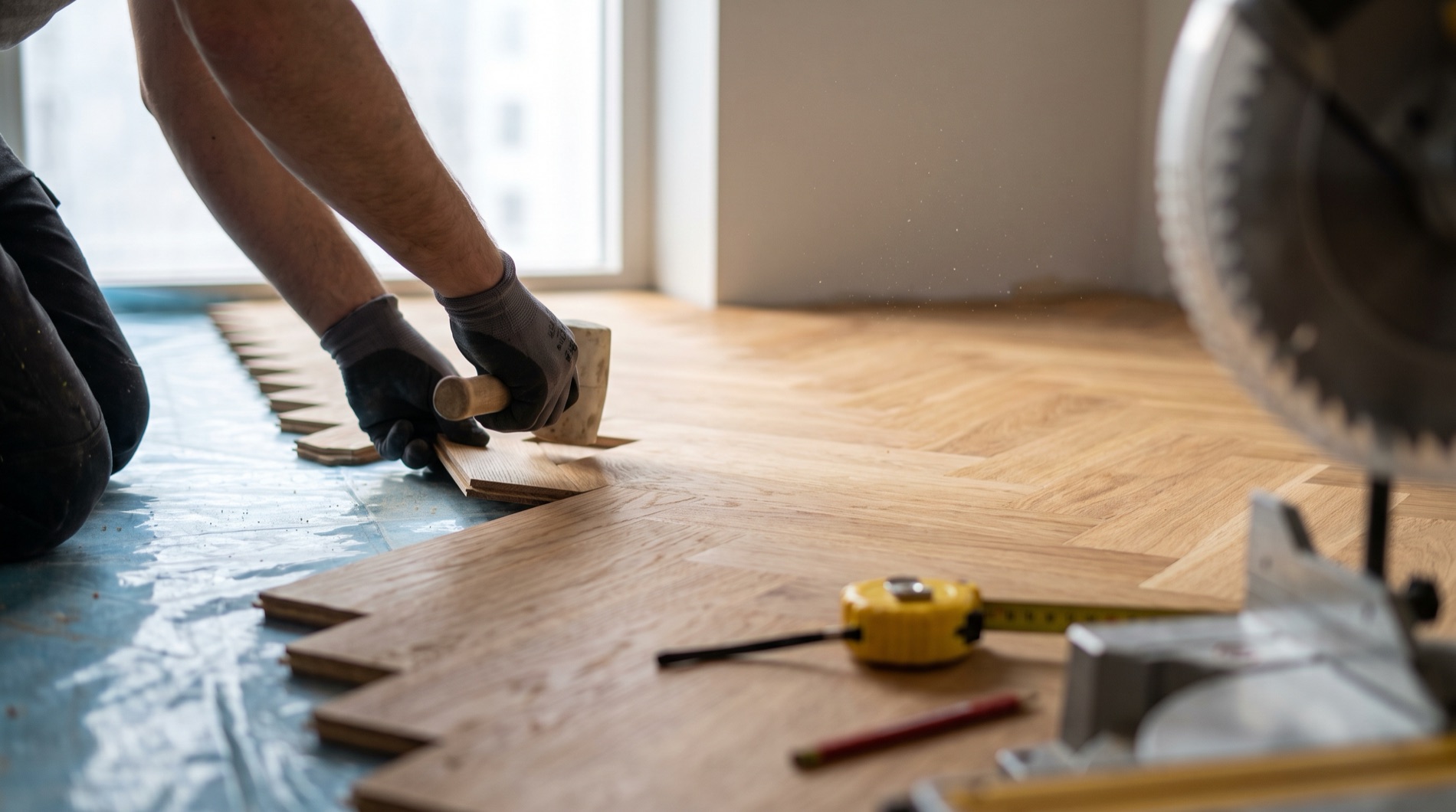
"How much more is the herringbone going to cost?" is the question that comes up the moment a homeowner in Old Town Alexandria, McLean, Arlington, Tysons, Bethesda, or any other DMV submarket shows us a Pinterest board of European-style hardwood floors. The honest answer in this market: 35-50 percent more in labor than the same square footage in straight lay, 8-15 percent more in materials, and a stricter subfloor flatness requirement that sometimes adds another floor-leveling line item before we can lay the first plank. After 20+ years installing hardwood across this metro, here is the real decision guide. The three pattern families, the labor multiplier math, the material waste reality, what NWFA actually specifies for subfloor flatness under parquet, real Potomac all-in pricing per pattern, where each pattern fits in DMV homes, install time, refinishing implications, and the FAQs we hear every quote.
The short answer for DMV homeowners
Quick answer
Herringbone is the visual upgrade. Straight lay is the value pick. The real cost delta in the DMV is roughly $3.50-5.50 per square foot all-in. Potomac standard hardwood (straight lay 3-5 inch white oak, nail-down, site-finished) runs $8.50 per square foot all-in. The same wood in a herringbone pattern runs $12-14 per square foot all-in. Chevron (the V-pattern often confused with herringbone) runs $13-16 per square foot all-in. The added cost comes from three places: roughly 35-50 percent more labor hours per square foot because every plank is a short fillet with a miter or end-grain cut, 15-20 percent material waste vs 7-10 percent for straight lay, and a stricter NWFA subfloor flatness spec (1/8 inch over 10 feet for parquet vs 3/16 inch over 10 feet for straight). On a 400 sqft Old Town dining-room and foyer, the pattern decision is roughly a $1,400-2,200 swing. On a 1,200 sqft McLean great room, it is a $4,200-6,600 swing. Worth it when the room is a focal point (foyer, dining room, library, principal living room). Not worth it on bedrooms, hallways, or whole-house installs unless the design specifically calls for the look.
The body of this guide walks through the three pattern families and the real difference between herringbone and chevron (they get confused constantly), the labor multiplier math from the installer side, the material waste reality, what NWFA specifies for subfloor flatness under parquet vs straight lay, Potomac DMV all-in pricing per pattern at three room sizes, where each pattern actually fits in DMV homes, install time, refinishing differences, and the FAQs.
The three pattern families: straight, herringbone, chevron
Quick answer
Straight lay is what most people picture when they hear "hardwood floor": planks running parallel in a single direction, randomly staggered for end joints. Herringbone is short rectangular fillets (typically 3-6 inches wide by 12-24 inches long) laid at 90-degree angles to each other, creating a zigzag pattern with square-end butt joints. Chevron is the V-pattern: each fillet has its ends cut at a 45-degree angle so the pattern forms continuous V-shaped points down the room. Herringbone and chevron get confused in Pinterest searches all the time. Both are parquet. Both cost more than straight lay. Chevron costs more than herringbone because the angled end cuts on every single plank are harder to produce and harder to install square.
| Pattern | Plank shape | Visual signature | Where you see it |
|---|---|---|---|
| Straight lay | Long planks 3-9 inches wide by 24-84 inches long, square ends, randomly staggered | Linear, continuous, one direction | Most US homes 1900-present |
| Herringbone | Short fillets 3-6 inches wide by 12-24 inches long, square ends, laid at 90-degree right angles | Zigzag with square-end joints | European apartments, pre-war NYC, French chateaux, modern transitional design |
| Chevron | Short fillets 3-6 inches wide by 12-24 inches long, ends cut at 45-degree angles, laid point-to-point | Continuous V-points, perfect chevrons | Versailles, Parisian Haussmann apartments, high-end modern |
| Versailles parquet | Square panels (typically 24x24 inches) with a basket-weave or interlocking pattern | Geometric square repeats | French palaces, very high-end commercial |
| Brick pattern | Straight planks with regular 50% offset (no random stagger) | Like a brick wall on the floor | Modern minimalist, some commercial |
This guide focuses on straight lay vs herringbone vs chevron because those are 95 percent of the pattern choices we quote in the DMV. Versailles parquet is a luxury subset that is gorgeous, but in this market it is a custom-order item priced separately per design. Brick pattern is straight lay with a tighter offset rule, and the labor and material costs are essentially identical to standard straight lay. The cost and complexity jumps live between straight and parquet (herringbone or chevron), not between the variations within each family.
⚠ Watch out
If you are picking patterns from Pinterest, double-check that what you saved is actually what you think it is. Roughly half the "herringbone" boards we get sent contain chevron photos and vice versa. The visual test: look at where two planks meet. Square end-to-side joint = herringbone. Angled point-to-point joint = chevron. Get this wrong on a quote and the labor cost is $1-2 per square foot off.
Why herringbone costs 35-50% more in labor
Quick answer
Straight lay is a high-throughput install: long planks, repetitive cuts, a crew of two can lay 200-300 square feet per day. Herringbone is the opposite: short fillets, every plank is a measured cut, every joint has to land tight on both axes (a herringbone joint is loaded in two directions at once), and the crew throughput drops to 100-150 square feet per day. Roughly double the labor hours per square foot. Chevron is harder still because every fillet needs a 45-degree miter cut on both ends, and getting the V-points to line up perfectly down a 20-foot room requires constant string-line checks. Chevron throughput is 80-120 square feet per day.
| Pattern | Crew throughput (per day, crew of 2) | Labor multiplier vs straight | Why |
|---|---|---|---|
| Straight lay (random) | 200-300 sqft | 1.0x (baseline) | Long planks, fewer cuts, joints align in one direction |
| Brick pattern | 180-280 sqft | 1.05-1.10x | Tighter offset rule means more careful spacing, marginal slowdown |
| Herringbone | 100-150 sqft | 1.35-1.50x | Short fillets, twice the cuts, joints loaded on two axes, constant square checks |
| Chevron | 80-120 sqft | 1.40-1.60x | 45-degree miter cuts on every plank end, perfect V-alignment required, no margin for error |
| Versailles panels | 40-80 sqft | 1.80-2.50x | Each panel is a custom layout; corner blending takes hours |
The structural reason herringbone is harder than the photos suggest: in a straight-lay floor, end joints can shift by 1/16 inch and nobody sees it because the eye reads the floor along the long axis. In a herringbone pattern, the eye reads the floor along both axes simultaneously, and a 1/16 inch joint gap or a 1-degree misalignment shows up across the whole field. Every fillet has to land square on the first try. We dry-fit the first 6-8 rows on every herringbone install, mark a string-line baseline, and check square after every third fillet. That is the time difference. We cover the actual install method (nail-down vs glue-down vs floating) and how it shifts further with parquet in our DMV installation methods guide.
The material waste factor (the hidden cost)
Quick answer
Straight lay typically wastes 7-10 percent of material. Herringbone wastes 15-20 percent. Chevron wastes 18-25 percent. The waste comes from end cuts (every herringbone fillet ends in a perimeter board, which leaves a short scrap that rarely fits anywhere else), from defects we cull on parquet that we would use on straight lay (a small knot at one end of a long straight plank lands hidden under furniture; the same knot on a 14-inch herringbone fillet sits dead-center in a focal-point pattern), and from the cull rate that comes with mitered chevron cuts (any chip-out on the miter sends that fillet to the scrap pile). On a 600 sqft herringbone foyer plus dining room, the material order is 720 sqft, not 660 sqft. That 10 percent extra wood at $4-7 per square foot of material is a $400-700 line item on top of the labor multiplier.
| Pattern | Waste factor | Order this much extra | What gets wasted |
|---|---|---|---|
| Straight lay (random stagger) | 7-10% | +7-10% on order | End cuts at room perimeter; minor defect culling |
| Brick pattern (50% offset) | 10-12% | +10-12% on order | Tighter offset means more cut-piece scrap |
| Herringbone | 15-20% | +18% on order (round up) | Every end cut leaves a short scrap; tighter defect tolerance |
| Chevron | 18-25% | +22% on order (round up) | Mitered cuts produce more scrap; any miter chip-out culls the whole fillet |
| Versailles panels | 20-30% | +25% on order (round up) | Custom-cut blocks; corner blending eats inventory |
One DMV-specific note on waste planning: white oak (the dominant DMV hardwood, 70 percent of our pattern installs) has lower defect cull than red oak or hickory. A herringbone install in pre-finished white oak runs closer to 15 percent waste; the same install in pre-finished hickory runs closer to 20 percent because hickory's natural color variation and knot density mean more visible-grade culls on short fillets. The full species comparison is in our DMV hardwood species guide.
Subfloor flatness: the silent dealbreaker
Quick answer
NWFA specifies 3/16 inch over 10 feet for straight lay hardwood and 1/8 inch over 10 feet for parquet (herringbone, chevron, or any other geometric pattern). That tighter parquet spec exists because a wavy subfloor shows up immediately in a herringbone field: each fillet sits on the subfloor independently, and a 1/4 inch low spot under a corner makes the joints around it open up visibly. Roughly 60 percent of DMV homes built between 1955 and 1995 fail the parquet flatness spec on the first measurement. Vienna and Falls Church split-levels, Arlington Cape Cods, Reston townhouses, McLean rebuilds with original tongue-and-groove plank subfloors are all common offenders. Floor leveling adds $1.50-3.50 per square foot to the install bid before any wood goes down. We measure every herringbone or chevron quote with a 10-foot straightedge across at least four axes per room before signing.
| Pattern | NWFA flatness spec | Typical DMV pass rate | If you fail spec, you need |
|---|---|---|---|
| Straight lay (nail-down or float) | 3/16" over 10 ft | ~85% of homes pass | Spot-shimming and patching ($300-800 most jobs) |
| Straight lay (glue-down over slab) | 1/8" over 10 ft | ~50% of slab homes pass | Self-leveling compound at $1.50-3 per sqft |
| Herringbone (any install method) | 1/8" over 10 ft | ~40% of DMV homes pass | Self-leveling compound at $1.50-3 per sqft |
| Chevron (any install method) | 1/8" over 10 ft | ~40% of DMV homes pass | Self-leveling compound at $1.50-3 per sqft |
| Versailles panels | 1/16" over 10 ft | ~10% of DMV homes pass | Full self-leveling pour at $3-5 per sqft |
The floor-leveling cost is the single biggest reason a herringbone quote comes in higher than the homeowner expected. We see Pinterest budgets of $12 per square foot all-in turn into real quotes of $14-17 per square foot once leveling is in the scope. The full breakdown of self-leveling vs spot-shimming vs replacing the subfloor is in our DMV floor leveling cost guide. The decision math: skip the leveling and the herringbone joints open up within 6-12 months as the floor settles. Do the leveling and the floor lays flat and stays flat for 30+ years.
Real DMV all-in pricing per pattern
Quick answer
Potomac all-in pricing for site-finished white oak (the DMV default) in three patterns: straight lay $8.50/sqft, herringbone $12-14/sqft, chevron $13-16/sqft. Pre-finished wood saves $0.75-1.25/sqft on labor (no sanding, staining, sealing on site) but costs $1.50-2.50/sqft more on materials. Engineered hardwood in any pattern runs $0.50-1.50/sqft cheaper than solid because the thinner wear layer needs less material and the click-lock or tongue-and-groove engineered profile installs faster. Pricing scales with room complexity: a square 400 sqft dining room is cheaper per square foot than the same 400 sqft split across a foyer, hallway, and partial living room with multiple corners.
| Pattern | Site-finished solid oak | Pre-finished solid oak | Engineered click-lock |
|---|---|---|---|
| Straight lay | $8.50/sqft all-in | $9.00-9.50/sqft all-in | $7.50-8.50/sqft all-in |
| Brick pattern | $9.00-9.50/sqft all-in | $9.50-10/sqft all-in | $8.00-9.00/sqft all-in |
| Herringbone | $12-14/sqft all-in | $12.50-14.50/sqft all-in | $11-13/sqft all-in |
| Chevron | $13-16/sqft all-in | $13.50-16.50/sqft all-in | $12-15/sqft all-in |
| Versailles panels | $22-32/sqft all-in | $22-32/sqft all-in | $18-26/sqft all-in |
All-in means material plus professional installation plus old flooring demo and removal. No add-ons after the quote. No "subfloor surprise" line item six days into the job. Subfloor leveling, when needed, is line-itemed on the quote with a measured spec before we start. Our DMV hidden-charges guide walks through the common quote traps and why we publish all-in numbers instead.
| Room size | Straight lay total | Herringbone total | Chevron total | Pattern premium |
|---|---|---|---|---|
| 200 sqft foyer + entry | $1,700 | $2,400-2,800 | $2,600-3,200 | +$700-1,500 |
| 400 sqft dining + foyer | $3,400 | $4,800-5,600 | $5,200-6,400 | +$1,400-3,000 |
| 800 sqft great room | $6,800 | $9,600-11,200 | $10,400-12,800 | +$2,800-6,000 |
| 1,200 sqft main floor | $10,200 | $14,400-16,800 | $15,600-19,200 | +$4,200-9,000 |
| 2,000 sqft whole house | $17,000 | $24,000-28,000 | $26,000-32,000 | +$7,000-15,000 |
One pricing reality the photos hide: at the whole-house level, the herringbone premium gets very real. A 2,000 sqft McLean rebuild in herringbone is roughly $25,000-28,000 all-in vs $17,000 in straight lay. That $8,000-11,000 difference funds a kitchen backsplash, a primary bath vanity, or about half a second-floor refinish. Most homeowners who say "I want herringbone everywhere" change to "herringbone in the focal rooms only" once we walk through the math. Foyer and dining room in herringbone, bedrooms and hallways in straight lay is a very common DMV split that delivers the visual upgrade where guests see it without the whole-house premium.
Where each pattern fits in DMV homes
Quick answer
Pattern choice is room-specific in this market. Herringbone reads as a deliberate design moment, which means it works best in rooms with a clear focal-point function: foyer, dining room, library, principal living room, primary bath (in tile pattern, not wood). Chevron reads as an even stronger design statement and works in the same rooms but skews modern, transitional, or French-style. It can read out-of-place in a 1955 colonial. Straight lay reads as warm, classic, and timeless in every DMV home type. Pre-war Old Town homes, Arlington Cape Cods, Vienna split-levels, Reston townhouses, McLean rebuilds, Tysons condos, Bethesda craftsman bungalows. Straight lay fits all of them. Herringbone fits the ones where you want a specific design statement.
| DMV home type | Straight lay fit | Herringbone fit | Chevron fit |
|---|---|---|---|
| Old Town Alexandria pre-war | Excellent (period correct) | Excellent (foyer, dining) | Strong (if French-influenced) |
| Arlington Cape Cod 1940s-50s | Excellent (period correct) | Good (dining only) | Skip (too modern for style) |
| Vienna split-level 1965-1985 | Excellent (matches era) | Skip (clashes with era) | Skip (clashes with era) |
| Falls Church 1970s ranch | Excellent (matches era) | Skip (clashes with era) | Skip (clashes with era) |
| Reston townhouse 1980s-90s | Excellent (neutral choice) | Good (foyer accent) | Skip (too design-forward for resale) |
| McLean rebuild 2010-present | Excellent (whole house default) | Excellent (focal rooms) | Strong (modern/transitional design) |
| Tysons high-rise condo | Excellent (great room default) | Excellent (foyer or full) | Strong (modern style) |
| Bethesda craftsman | Excellent (period correct) | Skip (clashes with era) | Skip (clashes with era) |
| DC row house pre-war | Excellent (period correct) | Excellent (parlor or dining) | Good (French parlor look) |
The "skip" calls on era-matched homes are not a hard rule, but they are the most common feedback we hear from real estate agents on resale staging. A 1972 Vienna split-level with herringbone in the dining room reads as a renovation choice that did not consider the house, and it does not lift the appraisal the way a deliberate period-correct material does. The same herringbone in a McLean 2018 rebuild reads as deliberate luxury and does lift the appraisal. Pattern is a design tool, and design tools work best when the room they live in is part of the same design language. We dig into the resale impact of flooring choices in our DMV resale flooring guide.
Install time difference
Quick answer
A 400 sqft straight-lay install takes 2 working days. The same room in herringbone takes 3-4 working days. Chevron takes 4-5 working days. The added days are pure layout and cutting time. Sanding, staining, and finishing on a site-finished floor take roughly the same time regardless of pattern because they happen after the field is laid. The whole-job timeline adds 1-2 days per 400 sqft of pattern install on top of straight-lay baseline. On a 1,200 sqft whole-floor herringbone, plan for 6-8 working days of installation plus the standard 7-14 day finishing and cure window covered in our refinishing timeline guide (the same finishing process applies to new installs).
| Job size | Straight lay install | Herringbone install | Chevron install |
|---|---|---|---|
| 200 sqft foyer | 1 working day | 2 working days | 2-3 working days |
| 400 sqft dining + foyer | 2 working days | 3-4 working days | 4-5 working days |
| 800 sqft great room | 3-4 working days | 5-7 working days | 7-9 working days |
| 1,200 sqft main floor | 4-5 working days | 6-8 working days | 8-10 working days |
| 2,000 sqft whole house | 7-10 working days | 10-14 working days | 13-16 working days |
Refinishing and maintenance differences
Quick answer
Solid herringbone and chevron refinish the same as straight lay: drum sand the field, fine sand to 120 grit, stain, three coats of poly. The drum sander does not care about pattern. The one operational difference: parquet is sanded in two diagonal passes (across the two axes the pattern runs on) instead of one. That adds 30-60 minutes to a Day 1 sand on a 600 sqft floor. Engineered herringbone or chevron has the same refinish-count limit as straight engineered (1-2 lifetime refinishes for 3mm wear layer, 3-4 for 4-6mm wear layer, see our engineered hardwood thickness guide). Solid herringbone can be refinished 5-7 times over its lifetime, same as solid straight lay. Day-to-day maintenance is identical: dust mop, occasional damp mop with a wood-floor cleaner, no steam mops ever.
The single maintenance gotcha specific to herringbone: spot board replacement is harder. On a straight-lay floor, replacing one damaged board means cutting it out and slipping a new board in along the grain. A 30-45 minute job per board for a skilled installer. On a herringbone floor, the damaged fillet is locked into a 90-degree joint on both ends, and replacing it requires cutting through both surrounding fillets to release the lock, then weaving the replacement back in. That is a 60-90 minute job per fillet, and it is harder to color-match because the new fillet has not aged with the rest of the floor. The fix: keep 20-30 sqft of attic stock from the original install. We bag it and label it on every herringbone job. Twenty years from now when a heavy pot lands on a fillet, the replacement comes from the same lot.
FAQs about herringbone vs straight lay
FAQ
Does herringbone make a small room look bigger or smaller?
Bigger in most cases. The zigzag pulls the eye across both axes of the room instead of down one axis, which makes a square room feel less rigid and a small room feel more dynamic. The exception is a long narrow hallway, where a herringbone pattern can feel busy and chaotic. Long narrow spaces almost always read better in straight lay running with the long axis.
FAQ
Can I do herringbone with LVP instead of hardwood to save money?
Yes, herringbone LVP is a real category and we install it. The labor multiplier is the same as hardwood (35-50 percent more vs straight lay) because the install difficulty is in the pattern, not the material. Herringbone LVP runs $9-12 per square foot all-in vs $6.50 for straight LVP. The visual is reasonable from 6+ feet away but does not match the depth of real wood up close. We cover the LVP material question in our LVP vs hardwood lifetime cost guide.
FAQ
Can I install herringbone over my existing hardwood floor as a refinish-equivalent?
No. Pattern is determined at install. Refinishing sands the surface but does not change the layout. To convert a straight-lay floor to herringbone, the existing floor has to come up and a new floor goes in. The cost is the full new-install cost, not a refinish cost. A 600 sqft conversion from straight to herringbone in our market runs $7,500-9,500 all-in including demo of the existing floor.
FAQ
Is herringbone harder to keep clean?
No. The joints in a herringbone floor are the same depth and seal quality as a straight-lay floor, and modern polyurethane finishes fill them flush. A dust mop catches dust the same way on both. The only real difference is visual: dust shows slightly less on a herringbone floor because the pattern breaks up the eye's read of the surface.
FAQ
Does the direction of the herringbone matter?
Yes, and we set this on the walk-through. The pattern's primary axis (the direction the zigzag points run) should align with the longest axis of the room. In a foyer, that usually means the points run toward the front door. In a dining room, perpendicular to the table. Getting this wrong is the most common DIY herringbone mistake. The pattern feels off and nobody can explain why.
FAQ
What plank size works best for herringbone?
For a residential DMV install, 4 inches wide by 16-20 inches long is the sweet spot. Wider than 5 inches reads chunky and slows install further because each fillet covers less area per cut. Narrower than 3 inches reads busy and the pattern loses definition from standing height. The 4x16 to 4x20 range is what most European parquet manufacturers ship as their standard residential herringbone product.
FAQ
Will herringbone increase my home's resale value?
In the focal rooms of a high-end home, yes. Appraisers in McLean, Bethesda, Great Falls, and Old Town routinely treat herringbone as a luxury finish that lifts comparable sales by 1-2 percent. In a starter home or a non-focal room, the lift is closer to zero and may even read as an over-improvement for the price band. We cover the resale framework in detail in the DMV resale flooring guide.
Bottom line: how to choose for your DMV home
Quick answer
Pick straight lay when the room's job is to feel warm and timeless. Pick herringbone when the room's job is to be a focal-point design moment. Pick chevron when you specifically want the French / modern luxe look and the era of the home supports it. Plan on a $3.50-5.50 per square foot all-in premium for parquet over straight lay, plus subfloor leveling if your home fails the 1/8 inch over 10 feet spec. Most DMV homeowners who start with "herringbone everywhere" end up with herringbone in the foyer and dining room and straight lay everywhere else. That split saves $5,000-12,000 on a typical main-floor install and delivers the visual upgrade exactly where it shows.
If you want a walk-through with the straight 10-foot edge in your home so you know whether you're already in spec or whether leveling is part of the bid, the all-in number with the right pattern for your room and your home's era, and a real install schedule on the calendar, that's what we do every day. Book a free in-home consult and we will measure, talk through pattern, and give you an all-in number before we leave. Same all-in pricing rule on every quote: material, labor, demo, and removal in one number. No surprise line items six days in.