The short answer
Quick answer
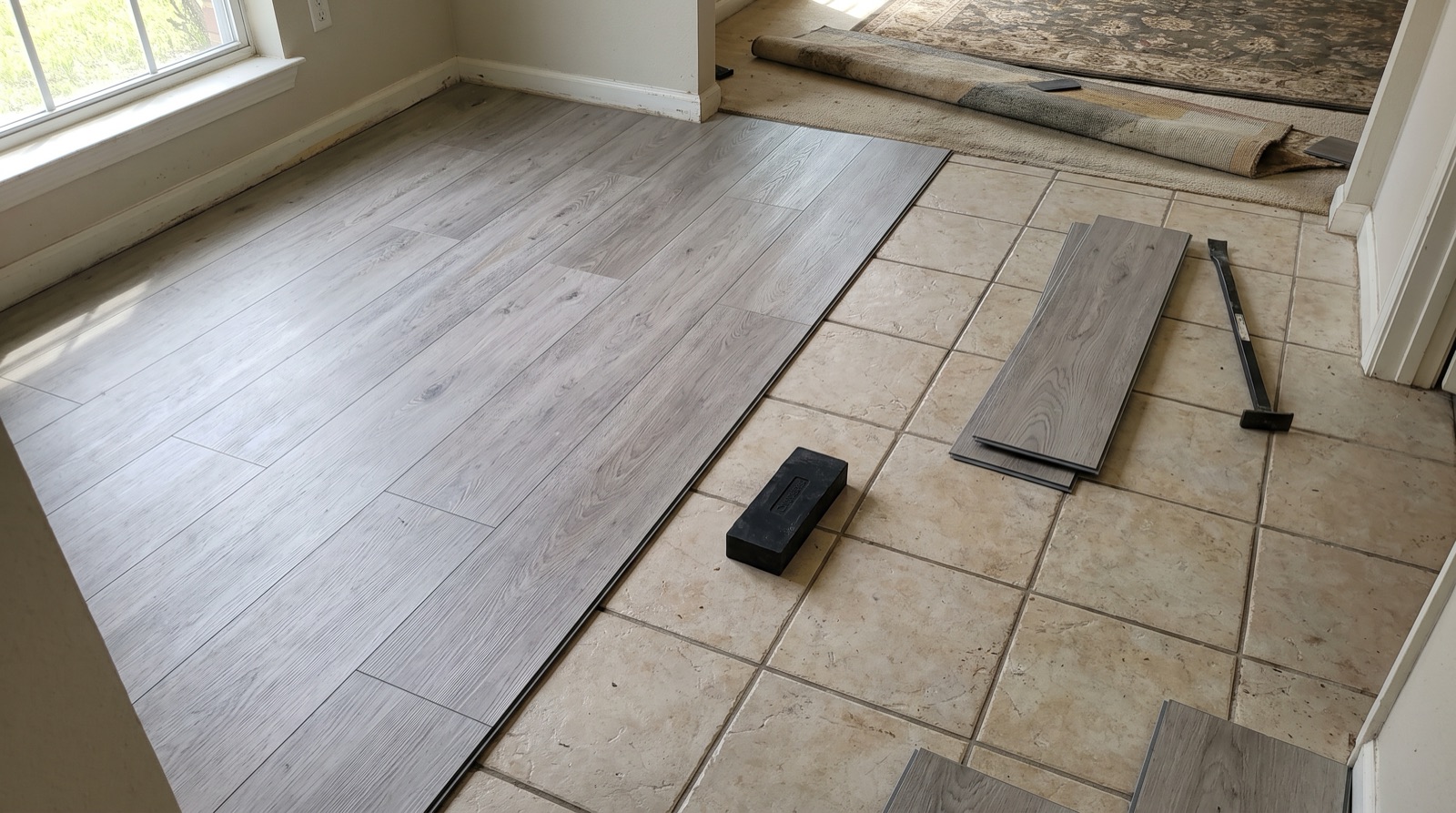
Yes, in most DMV homes you can install vinyl plank directly over tile, and it's one of the most common jobs we do. The tile has to be solid, reasonably flat, and free of loose or hollow pieces, and you float a rigid-core click-lock plank on top rather than gluing it down. The two things that stop the job are wide or deep grout lines that telegraph through, and the added floor height causing trouble at doorways, appliances, and the toilet. When the tile is a good substrate, going over it saves you the cost and mess of demo.
This is one of the questions we get most often in Alexandria, Arlington, and Fairfax, usually from someone staring at dated ceramic in a foyer, kitchen, or bath and hoping they don't have to pay to jackhammer it out. Good news: usually you don't. Vinyl plank over tile is a legitimate, long-lasting install when the tile underneath is sound. The whole answer is in reading the tile correctly first, so here's exactly how we decide, what can go wrong, and what it costs. For the material itself, our vinyl plank installation cost guide and glue-down vs floating LVP breakdown are the companion pieces.
When you can go over tile, when you can't
Quick answer
Go over tile when it's well-bonded, flat within about 3/16 inch over 10 feet, and the grout lines are tight. Don't when tiles are cracked, hollow-sounding, or lifting, when the floor has a real slope or dip, or when the extra height traps a dishwasher or creates a trip hazard. Solid tile is a great substrate; failing tile is not.
A floating floor only performs as well as the surface under it. Tile is actually a good candidate because it's hard, stable, and doesn't compress. The test is simple. Tap around with a hard object and listen: a solid "tick" means the tile is bonded, a hollow "thock" means the mortar has let go underneath and that tile will move. Any cracked, loose, or hollow tile has to be re-bonded or removed and patched before the plank goes down, because a floating floor faithfully transmits whatever moves below it. Then check flatness with a straightedge. DMV housing stock is old enough that this matters: 1960s to 1980s ceramic set in a thick mortar bed is often wavy, and older foyer and bathroom tile can dip toward a drain. If the floor isn't flat, that gets fixed first (more on that below).
The grout-line problem (telegraphing)
Quick answer
Grout lines wider than about 1/4 inch or deeper than 1/8 inch can telegraph, meaning you feel and eventually see their pattern through the plank. A thick rigid-core (SPC) plank bridges narrow grout lines; thin flexible LVP does not. Wide or deep grout gets skim-coated flush before the floor goes down.
This is the number-one reason a vinyl-plank-over-tile job goes wrong, and it's avoidable. Vinyl plank is only so thick. Over time, foot traffic presses it down into any void, so the grid of recessed grout lines slowly prints through the surface. You notice it first with bare feet, then you start to see it in raking light. Whether it happens depends on two things: how deep and wide the grout joints are, and how rigid the plank is. Tight, flush grout lines under a stiff SPC plank are a non-issue. Wide saltillo or old 12-inch ceramic with 3/8-inch recessed joints is a problem. The fix is a cementitious skim coat or embossing leveler troweled over the tile to fill the grout lines flush with the tile face, which gives the plank a continuous surface to sit on. If you want the difference between rigid SPC and softer WPC cores, our WPC vs SPC guide covers it, and SPC is what we reach for over tile.
The height problem: doorways, dishwasher, toilet
Quick answer
Going over tile raises the floor by roughly 1/4 to 1/2 inch. That can trap a dishwasher under the counter so it can't come out, raise the floor above the toilet flange, and require undercutting door casings and shaving door bottoms. Every doorway also needs a transition to the neighboring room's floor.
You're not removing the old floor, so you're adding to the stack height, and that catches people off guard. Three spots matter most. First, the dishwasher: if you tile-and-plank right up to it, the new floor can lock the dishwasher in place under the countertop, so it can never be pulled out for service or replacement without cutting the floor. We plan for that. Second, the toilet: raise the floor and the toilet flange can end up below the finished surface, which needs a flange spacer to seal correctly, so a toilet pull-and-reset is part of a bathroom job. Third, doors and trim: interior doors may need a half-inch trimmed off the bottom to swing, and door casings get undercut so the plank tucks under cleanly instead of being caulked around. Finally, where the new floor meets carpet, hardwood, or another tiled room, you need a transition strip to bridge the height change. Our guide on flooring transitions between rooms walks through those.
Which vinyl plank to use over tile
Quick answer
Use a rigid-core SPC click-lock plank, ideally 5mm or thicker with an attached pad and a 20-mil or better wear layer. The rigid core spans minor surface irregularities and resists grout-line telegraphing far better than a thin, flexible glue-down plank.
Over tile, the plank is doing double duty as flooring and as a bridge over grout joints, so stiffness wins. A stone-plastic composite (SPC) plank has a dense, rigid core that stays flat and doesn't dish into small voids the way a flexible plank does. Look for total thickness of about 5mm or more and an attached foam or cork pad, which cushions the plank against the hard tile and quiets the floor. Wear layer is the durability spec that actually matters for how long the floor lasts under traffic and pets; 20 mil is our default for busy DMV households, and our LVP wear layer guide explains why 12 mil isn't enough for a main floor. One note: if the plank already has an attached pad, don't add a second underlayment. Double-padding makes the floor spongy and can void the click-joint warranty.
Float it, don't glue it
Quick answer
Over tile, install a floating click-lock floor, not a glue-down. Adhesive doesn't bond reliably to glazed tile and telegraphs every grout line hard. A floating floor sits on top as one connected sheet with an expansion gap at the walls.
Glue-down LVP needs a smooth, porous, absolutely flat surface for the adhesive to grab, and glazed tile is the opposite of that: slick, and interrupted by grout channels the glue can't fill. Glue-down over tile also transmits every joint straight through. So the answer over tile is almost always a floating click-lock floor, where the planks lock to each other and rest on the tile without being fastened to it. That's also why the surface prep below matters so much: a floating floor moves as one piece and mirrors the flatness of what it sits on. Leave the required expansion gap around the perimeter, hidden under baseboard or quarter-round, so the floor can expand and contract with DMV's humidity swings without buckling.
What we do to the tile first
Quick answer
We re-bond or remove loose tiles, fill wide or deep grout lines and any dips with a skim coat or self-leveler, clean the surface, and check flatness with a straightedge. Only then does the plank go down. Prep is what makes an over-tile floor last.
The install itself is the easy part; the prep is where the job is won or lost. Our sequence over tile: sound-test the whole floor and deal with anything hollow or cracked, then knock down any high spots and fill low spots and wide grout lines with a cementitious patch or self-leveling compound so the surface reads flat under a straightedge. We vacuum and clean so nothing telegraphs as a bump, undercut the door casings, and lay out the planks to avoid narrow slivers at the walls. If your tile turns out to be uneven enough to need real leveling, that's a line item worth understanding up front, so our floor leveling cost guide spells out what that runs. When we open up a floor and find rot or movement under the tile, that's a different conversation, which is the kind of thing we cover in what we find under DMV floors.
What it costs vs ripping the tile out
Quick answer
Going over sound tile skips demo, which typically saves about $2 to $4 per square foot plus dumpster and dust. Our all-in LVP is $6.50 per square foot including material, installation, and removal of old floors, and leaving good tile in place is one of the few times "removal" isn't needed.
Tile demo is genuinely hard labor: it's noisy, throws dust through the whole house, fills a dumpster fast, and sometimes damages the subfloor on the way out, which then needs repair. Skipping it when the tile is a good substrate is real money saved, usually in the range of $2 to $4 per square foot of demo plus disposal. Our all-in vinyl plank price is $6.50 per square foot, which normally includes tearing out and hauling the old floor. Going over tile is one of the few cases where that removal step drops out, though any skim-coating or leveling the tile needs will offset part of the savings. The honest version: if your tile is solid and flat, going over it is cheaper and cleaner. If it's cracked, hollow, or badly out of level, paying to remove it can be the better long-term call. We tell you which one you've got when we look.
Should you do it in a bathroom?
Quick answer
You can, and vinyl plank is waterproof, but a bathroom means pulling and resetting the toilet, handling the raised flange, and accepting that water can still get under a floating floor at the edges. For a small bath it's a fast, affordable refresh; for a full remodel, removing the tile is often the cleaner path.
Vinyl plank is a waterproof surface, so a powder room or hall bath over existing tile is a common, low-drama upgrade. The catch is that a floating floor isn't a sealed system: standing water at a seam or the perimeter can migrate underneath, so it's a refresh, not a waterproofing strategy. Our full breakdown of vinyl plank in bathrooms covers the perimeter sealing that keeps water off the subfloor. And a bathroom always adds the toilet: it comes off, gets a flange spacer for the new height, and gets reset with a fresh wax seal. For a quick cosmetic update that's fine. If you're gutting the bathroom anyway, you're already paying for demo, so leaving the old tile in place stops making sense. Our DMV bathroom flooring guide weighs plank against tile for the room properly.
FAQs about vinyl plank over tile
Can you put vinyl plank flooring directly on tile?
Yes, in most cases. If the tile is well-bonded, flat, and free of loose or cracked pieces, a rigid-core floating vinyl plank installs directly on top. Wide or deep grout lines get skim-coated flush first so they don't telegraph through the plank over time.
Will the grout lines show through vinyl plank?
They can if the grout joints are wide or deep and the plank is thin. A thick, rigid SPC plank bridges tight grout lines fine. For wider or recessed joints, we fill them level with a skim coat before installing, which prevents the grout grid from printing through.
Do you need underlayment for vinyl plank over tile?
Usually no extra underlayment. Most quality SPC planks have an attached pad, and adding a second one makes the floor spongy and can void the warranty. What the tile does need is to be flat and clean, with wide grout lines filled, so the floating floor sits evenly.
How much height does vinyl plank add over tile?
Roughly 1/4 to 1/2 inch, depending on plank thickness. That's enough to matter at doorways, under a dishwasher, and at the toilet flange, so those get planned for: door bottoms trimmed, casings undercut, transitions added, and the toilet pulled and reset in a bathroom.
Is it cheaper to go over tile or remove it?
Going over sound tile is cheaper because it skips demo, which saves roughly $2 to $4 per square foot plus disposal. But if the tile is cracked, hollow, or badly uneven, removal is often the better value long-term. We assess the tile and tell you which case you're in before quoting.
Bottom line
Yes, you can install vinyl plank over tile, and in a lot of DMV homes it's the smart move: it skips the noise, dust, and cost of tile demo and gives you a fresh, waterproof floor in a day or two. The whole thing hinges on reading the tile first. Solid, flat tile with tight grout lines is an excellent substrate for a rigid-core floating plank. Loose, cracked, or wavy tile needs prep or removal, and every job needs a plan for the extra height at doorways, appliances, and the toilet. Get those right and the floor lasts as long as any other LVP install. If you're in Alexandria, Arlington, Fairfax, or anywhere in the DMV and want a straight answer on whether your tile is a go, get a free in-home quote and we'll tell you exactly what your floor needs, including whether going over the tile is the right call or a false economy.